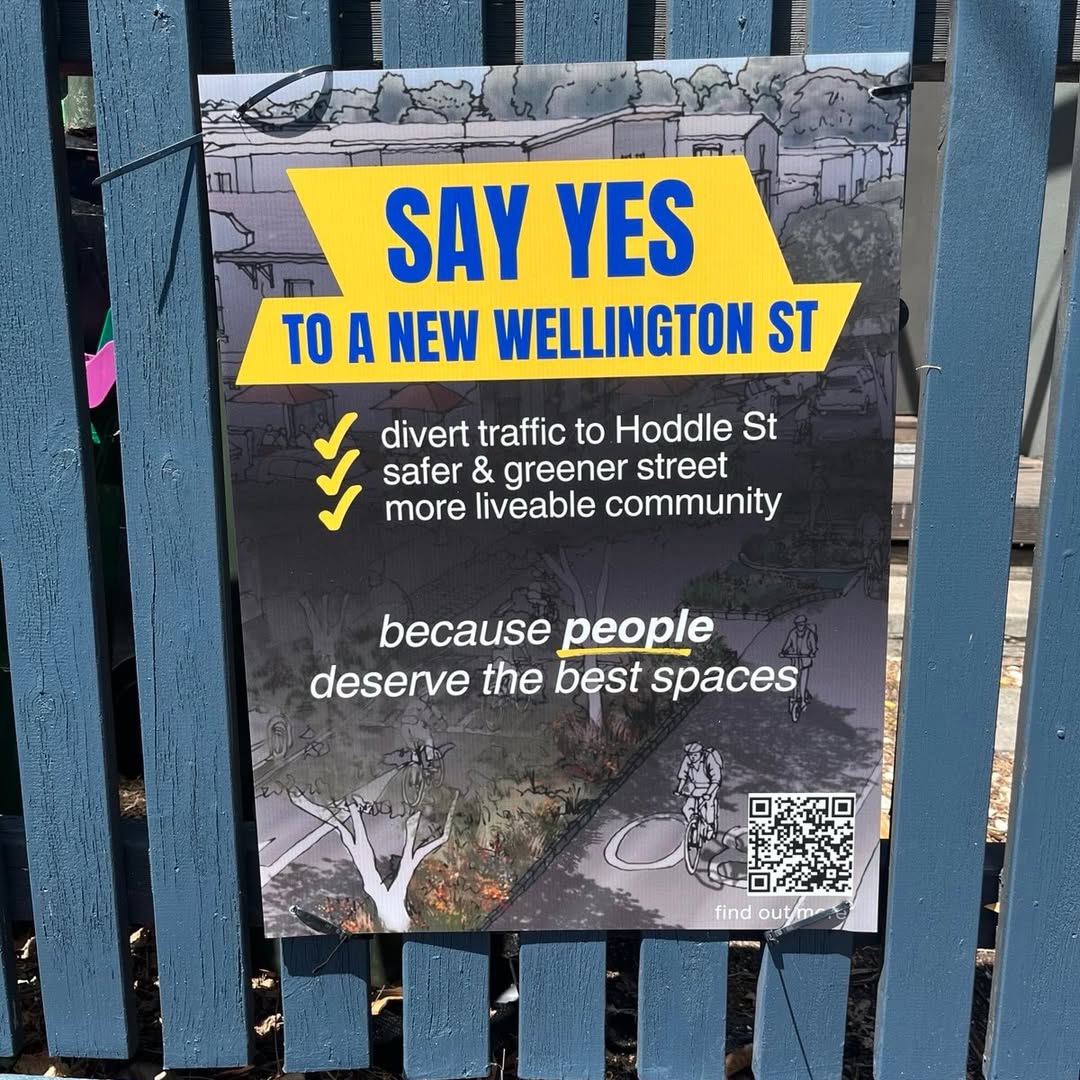
Local Collingwood residents have started a petition to upgrade Wellington St, find out more below.
Introducing Say Yes to a new Wellington Street: ‘We’re a bunch of people from Collingwood who would love to enjoy a green, safe and pleasant Wellington Street – and put an end to the thousands of cars that rat-running through our neighbourhood.’
- Are you with us? Then please add your name to our open letter. We really need your support to make this happen.
- Questions? Ask John, our friendly neighbourhood traffic aficionado
- Would you like a corflute? Ask here.
- Listen to Alex Lamb talking about Wellington Street from 11:40 minute mark. (YarraBUG Radio on 3CR Radical Radio, Mon 23 Feb 2026)
‘The council put an end to rat running in Fitzroy years ago, but Collingwood is still used as a short cut. Wellington Street can get chockers full of bumper to bumper traffic at peak times, filling the neighbourhood with air pollution, noise and endangering pedestrians and cyclists.’
‘So the Council has now proposed some design options (see below) to stop this non-local traffic passing through, making it a better street to walk, ride, play, and have a beer on.
It’s a great idea! You might have ideas for tweaks to the design here and there, and that’s great. Let’s just agree to this massive improvement in principle. Let’s get this traffic out of our neighbourhood and make a cleaner and safer street for all.’
More detail (Q&A) So what’s actually being proposed?
|
Option 1: shared street |
Option 2: wider bike lanes |
|
30km/h |
30km/h |
|
Cyclists & cars share road |
Wider painted bike lanes |
|
10 fewer car parks |
12 fewer car parks |
|
34 trees |
12 trees |
|
One full modal filter |
Three partial modal filters |
Either option is an improvement, but overall, the shared neighbourhood street design is the better outcome, offering a calmer street, more trees, and more car parking, while also delivering a safe environment for people biking.
Some people think that this upgrade is for cyclists only, but that’s not the case. The project has been designed to improve traffic for locals by diverting through-traffic away from our neighbourhood. As Melbourne gets bigger and more apartments get built here and in surrounding areas, congestion on Wellington Street will get worse – unless we do something about it now.
How many bike accidents have there been on Wellington Street?
25 accidents on the stretch of Wellington Street between Johnston Street and Queens Parade between 2022-2025. This number includes: 20 cyclists and four motorcyclists. This is an average of 8 bad bike accidents a year – i.e. bad enough for someone to call an ambulance or report it to the local or state government. Many more go unreported.
One person who signed this Open Letter told us that a car hit her and her toddler as she cycled her cargobike up Wellington Street to pick up her child from Clifton Hill Primary School. Luckily the cargobike frame protected them, but it was a rattling experience.
Won’t these cars rat-run through other streets in Collingwood to avoid Wellington Street?
Unlikely, as that would add a lot of inconvenience to their route. For the traffic passing through from other parts of Melbourne, Wellington Street is only one section off a bigger journey and people make up their minds about the best routes when they start their journey.
A glance at Google Maps can easily tell you the quickest route to your destination, and it’s not rat-running through a maze of side streets in the middle of your trip.
We’ve also got plenty of case studies to look at: only a few hundred metres away in Fitzroy and North Carlton: George Street, Napier Street and Canning Street were all upgraded to block through-traffic, and that did not push traffic onto surrounding streets.
The traffic boffins at Council have also thought about this to the nth-degree. Their modelling found that the base case scenario is there is no increase in the traffic down Gold and Keele street. They’re currently working with traffic engineers to incorporate community feedback and eliminate any risk of rat-running through side streets. Remember, the whole point of the design is to stop through traffic from rat-running through Collingwood.
Will I still be able to drive on Wellington Street and around my neighbourhood?
Yes. The design ensures local residents can access their homes and everyone can get to destinations in Collingwood. It just makes the route extremely inconvenient for non-local traffic driving straight through.
What is the cost of this upgrade?
The shared street option is significantly cheaper than the cost of putting in separate bike lanes. It would cost only a fraction of what it cost to build separated bike lanes on the southern end of Wellington street, even after factoring in the skyrocketing price of construction since covid. To put it in another context, either option would cost less than 1% of the total annual budget of the Council.
The Council also now receives $3 million a year to spend on active travel thanks to the Greens’ amendments to the Victorian Congestion Levy legislation.
There are other cost efficiencies too: Wellington Street needs to be resurfaced and many crossings are uneven and need to be improved to ensure people in wheelchairs can cross more safely.
Doing this full upgrade to transform the street enables a suite of upgrades that need to happen – the resurfacing, the improvements to disability access, the planting of trees, the safer pedestrian crossings.
What is a modal filter and how will they reduce rat-running?
A modal filter is a physical structure ie. bollard, that blocks movement of cars but allows pedestrians and cyclists through.
Modal filters are used to block cars from driving the complete length of Wellington Street and will force cars onto local streets. As rat-running will take longer, non-local drivers will therefore choose to not drive along Wellington Street. Local cars can still drive around, although you might need to plan a slightly different route.
How many cars pass through anyway?
Up to 11,000 cars pass through Wellington Street on a busy day – and only 3,000 of those are locals. By making it less convenient for the 8,000 of them that fang through, we can take 8,000 cars off our roads. That’s up to 800kg of CO? a day* (*thanks ChatGPT).
Has the Council consulted with other state government bodies and emergency services?
The council has consulted with Vicroads, Department of Transport and emergency services as part of the initial consultation, and will continue to do so as part of the final design work. The project will consider emergency worker access – currently emergency services police/firefighters/ambulances have said that the proposed plans will not impact response times.