Elizabeth Street Protected Bike Lanes: A history (2024 – 2026) – Part 3


Elizabeth Street is an east-west street in North Richmond, between Hoddle Street and Church Street. To the west, over Hoddle Street, it links to Albert Street, which hosts separated and then protected bicycle lanes heading into the central business district.
Note: the original Elizabeth Street history page has been split into Part 1 (1993 – 2019), Part 2 (2020 – 2023) and Part 3 (2024 – 2025) as it’s our websites most popular page since starting the site in 2005!
These pages exist to both document and counter the false narrative there has been, to broadly quote, ‘no community consultation’ in relation to these lanes or issues raised by community members or accessibility concerns.
These pages contains amongst many things, a lot of text, images, links and embedded links so it may load differently on devices or slow connections. Please contact us if you have additional publicly available Elizabeth Street references that can be included here.
- Elizabeth Street Protected Bike Lanes: A history (1993 – 2019) – Part 1
- Elizabeth Street Protected Bike Lanes: A history (2020 – 2023) – Part 2
- Elizabeth Street Protected Bike Lanes: A history (2024 – 2026) – Part 3
26 November 2024: Yarra Council: Notice of Motion No.19 of 2024 – motion includes move to narrow Elizabeth Street lanes + Remove Coppin Street pop-up bike lanes
26 November 2024 Yarra City Council Meeting Agenda: Item 8.1 – Notice of Motion No.19 of 2024 starting on page 125. Refer to point 11: Elizabeth Street and 12: Coppin Street.
Elizabeth St cycle lane
- That a report be presented to the February 2025 Council meeting cycle to consider options and costs in relation to:
(a) Modifying the Elizabeth St, North Richmond cycle lane to:
(i) allow both dedicated bike lanes and parking on both sides of Elizabeth St, until Council forms an opinion on its future; and
(b) Providing advice on:
(i) bike lane widths east and west of Lennox St;
(ii) buffer widths east and west of Lennox St;
(iii) traffic lane widths east and west bound on Lennox St; and
(iv) parking lane widths noting the curb to curb widths of Lennox St; and
(c) The report is to include traffic engineering advice and costings to make the adjustments for the trial and costing for the works to be permanent and any required approvals from the Department of Transport and Planning.
Coppin Street ‘bike-friendly’ pop-ups
- That a report be presented to the February 2025 Council meeting cycle to consider options and costs in relation to:
(a) the removal of the ‘bike-friendly’ pop-ups in Richmond so as to modify the Coppin Street, Richmond cycle lanes to:
(i) Remove the bike-friendly pop-up barriers in Richmond at the intersection of Coppin Street and Swan Street, both north and south of this intersection, removing the traffic bottlenecks currently occurring; and
(ii) Remove the ‘bike-friendly’ pop-up barriers in Richmond at the intersection of Coppin Street and Bridge Road, both north and south of this intersection, removing the traffic bottlenecks currently occurring; and
(b) Detail the amount currently in Council’s Victorian Government Safe Local Roads and Streets Program and a projection for funds expected in 2025/2026. This data should be broken down into projects and zones.
- 8.1. – Notice of Motion No.19 of 2024 – New Direction for Yarra (pdf, six pages)
26 November 2024 Yarra City Council Meeting Minutes: Item 8.1. – Notice of Motion No.19 of 2024. Refer to point 11: Elizabeth Street and 12: Coppin Street
Elizabeth St cycle lane
(b) Providing advice on:
(iv) parking lane widths noting the curb-to-curb widths of Lennox St; and
(c) The report is to include:
(i) traffic engineering advice and costings to make the adjustments for the trial and costing for the works to be permanent;
(ii) any required approvals from the Department of Transport and Planning;
(iii) include a plan to seek funding from the State Government to assist Council in performing any works recommended; and
(iv) include previous collected consultation data from the community
The amendment was accepted by the mover and seconder and incorporated into the motion.
Amendment
Moved: Councillor Wade
Elizabeth St cycle lane
(iv ) include previous collected consultation data from the community and any other information previously provided to Council.
The amendment was accepted by the mover and seconder and incorporated into the motion.
Amendment
Moved: Councillor Harrison
Coppin Street ‘bike-friendly’ pop-ups
12. That a report be presented to the February 2025 Council meeting cycle to consider the results of the current ‘bike friendly’ pop-up trial and community consultation, community feedback via ‘Have Your Say’ and traffic counts from Coppin and neighbouring streets to measure diversion of vehicles, together with options and costs in relation to:
(a ) Alteration of the configuration of the trial pop-ups to reduce the vehicle traffic congestion particularly at the Coppin Street and Swan Street intersection The amendment was accepted by the mover and seconder and incorporated into the motion.
Amendment
Moved: Councillor Crossland, Seconded: Councillor Wade
Coppin Street ‘bike-friendly’ pop-ups
- That a report be presented to the February 2025 Council meeting cycle to consider:
options and costs in relation to: the results of the current ‘bike friendly’ pop-up trial and community consultation, as well as the following:
(a ) Council notes that:
(i) Permanent changes to existing infrastructure cannot be made as part of a trial, such as the central media island on Coppin St at the intersection of Swan St;
(ii) The Southbound left turning traffic lane from Coppin St into Swan St will be reinstated as part of a permanent design; and
(iii) No other turning lanes were temporarily removed as part of the ‘bike friendly’ pop-up trial on Coppin St.
(b ) Exploration of different design solutions that could allow for greater continuity of separated cycling treatment as part of a permanent design, including bi-directional treatment;
(c ) Traffic counts, including rationale and potential means of address of perceived increased traffic on Coppin St; the removal of the ‘bike-friendly’ pop-ups in Richmond so as to modify the Coppin Street, Richmond cycle lanes to
(d ) Details of the amount currently in Council’s Victorian Government Safe Local Roads and Streets Program and a projection for funds expected in 2025/2026. This data should be broken down into projects and zones.
Division
For: Councillors Crossland, McKenzie and Wade
Against: Councillors Aston, Davies, Gomez, Harrison, Ho and Jolly
- Amendment lost: Yarra Council Meeting 26 November 2024 (pdf, two pages)
31 January 2025: Critical Mass Yarra
A group of people came together on Friday 31 January to form a “Critical Mass” of people on bikes who rode to remind people and decision makers that bike lanes and infrastructure in Yarra are important.
Critical Mass usually leaves the State Library at 5.30pm on the last Friday of each month and this month they rode through the CBD, Fitzroy, Collingwood, East Melbourne and Richmond, finishing at the Richmond Town Hall for speeches.
Critical Mass rode through both Elizabeth and Coppin Sts in Richmond, which were the focus of the protest as the Yarra Council has proposed narrowing the Elizabeth Street bike lanes to provide parking and the removal of bike friendly intersection popups on Coppin Street.
Speeches at the Town Hall focussed on the needs of local High School students to have safe bicycle and walking routes to allow them independence, and the need for local residents to prioritise safety over convenient parking. Critical Mass Melbourne events are an opportunity for people on bikes to come together over a common issue, have a fun ride and enjoy road spaces that aren’t normally available.
In November 2025, Critical Mass will celebrate 30 years of rides across Melbourne.
March 2025: Austroads Guide to Traffic Management (AGTM)
To strengthen connections to best-practice planning and design principles, and draws on internationally recognised frameworks
Austroads is the association of the Australian and New Zealand transport agencies, representing all levels of government. On 15 March 2025, AustRoads published Improving Austroads Guidance for Cycling and Micromobility Planning.
‘The report highlights the importance of planning for the increasing numbers of people on bikes and people on e-scooters. Among its key recommendations, the report suggests updates to the Austroads Guide to Traffic Management (AGTM) to strengthen connections to best-practice planning and design principles, and draws on internationally recognised frameworks. The report proposes a glossary of common terms, which will help ensure that terminology is clearer and better reflects the diversity of road users.’
The new report includes key safety requirements for bike lane widths: ‘Riders in cycle lanes of not less than 2m wide and 1m buffer to general traffic up to a speed of 40kph‘ and ‘Minimum 2m bike lanes with 0.8m – 1.2m buffer alongside kerbside activity‘ included in Appendix A Cycling Level of Service Tool (Pages 71-74)
8 April 2025: Media Release – Residents support safe bike lanes in Yarra

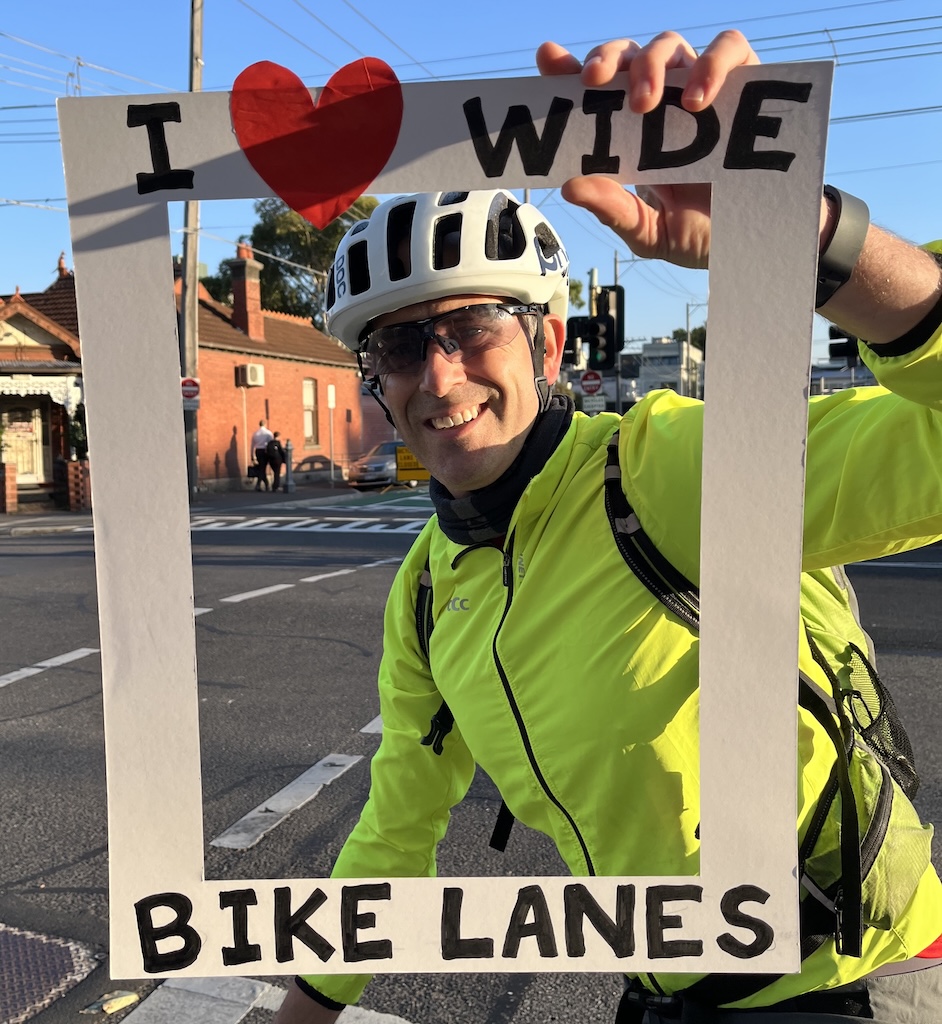
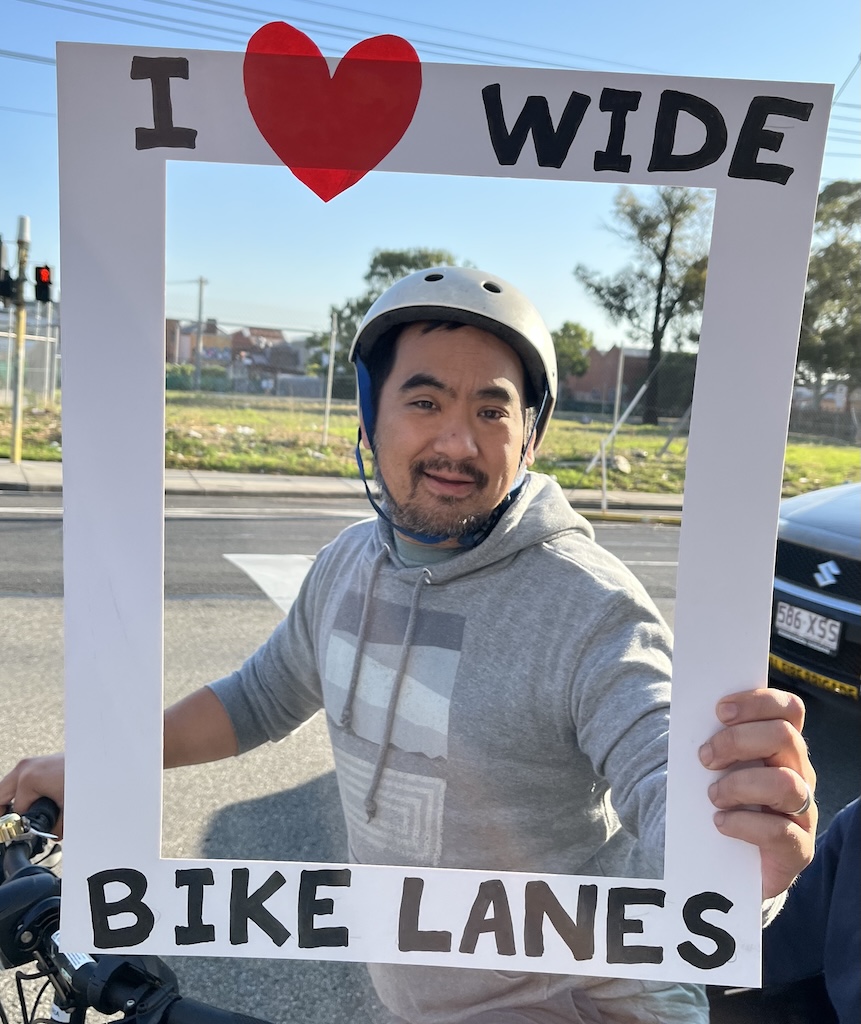
People love wide bike lanes – photos taken between 7:30am and 9am during 4 March 2025, Super Tuesday Bike Count on Elizabeth Street, Richmond. Over 1100 people have signed the petition ‘Don’t risk our safety in 2025 – tell Yarra Council not to remove safe cycling lanes’ to save the much-loved lanes Elizabeth Street and Coppin Street protected bike lanes in Richmond, after new councillors proposed removing successful bike lane infrastructure at a council meeting in November 2024 soon after being elected. A crowd is expected to attend Richmond Town Hall at 6pm in a protest for safe bike lanes, ahead of the Yarra City Council meeting tonight (Tuesday 8 April 2025) at 6.30 pm.
At the meeting, councillors will vote on a series of options about bike lanes in Richmond – from maintaining the cycle lanes – which the previous council had voted unanimously to make permanent – to narrowing the lanes, or removing them altogether.
8 April 2025: Yarra Council: 7.1. Elizabeth Street Bike Lane Trial Update and 7.2. Coppin Street Cycling Corridor
8 April 2025 Yarra City Council Meeting Agenda: Item 7.1. Elizabeth Street Bike Lane Trial Update and Item 7.2. Coppin Street Cycling Corridor. 6.30pm, Richmond Town Hall, 333 Bridge Road, Richmond
Executive Summary
The Elizabeth Street protected bike lane corridor was installed in July 2020 following a Council resolution in December 2019. Council resolved to deliver the project as a 12-month trial. The trial has subsequently been extended via various Council resolutions.
The Elizabeth Street trial involved ‘road space reallocation’ and specifically the installation of separated bike lanes – this required the removal of car parking on the north side of the street (due to the width of the road pavement and what is considered appropriate standards). On the northern side of Elizabeth Street (69 spaces) were removed to accommodate the bike lanes with 76 spaces removed in total.
Elizabeth Street forms part of the ‘New Deal for Cycling’ (NDC) network as defined in the Yarra Transport Strategy (YTS). It is also designated by the State Government as a Strategic Cycling Corridor (SCC). Attachment 1 shows the location of Elizabeth Street in the context of cycling routes (map of the New Deal for Cycling Network). Elizabeth Street has a kerb-to-kerb width of approximately 15 meters.
The kerb-to-kerb width of the road would need to be approximately 17 metres to accommodate fully compliant protected bike lanes, two traffic lanes, have parking on both sides of the road and meet recommended design standards and guidelines.
Officer Recommendation / That Council:
- Resolves to retain the existing Elizabeth Street bike lane trial infrastructure in place until permanent treatment designs are resolved.
- Finalises the concept design work for the permanent treatment based on the existing trial layout (Option 1) and present these designs to Council by December 2025 for consideration for release for community consultation.
- Reports the results of the community engagement outlined in Point 2 above to Council before June 2026 and seek endorsement of a final concept design.
- Completes a review of parking restrictions (exploring additional opportunities for parking in the surrounding area).
- Maintain the road using existing patch ups.
- Defers the road re-sheet program to coincide with the construction of a permanent bike lane treatment.
History and background
The Elizabeth Street bike lane has a significant history. The following is a brief summary
2019
- In December 2019, Council resolved to install protected bike lanes on Elizabeth Street as a 12-month trial.
- Parking on the northern side of Elizabeth Street (69 spaces) and 7 on the southern side were removed to accommodate the bike lanes that were designed to meet the requirements of State design guidelines.
- Council resolved (December 2019):
‘That Council:
(a) note the officer report regarding the proposed Elizabeth Street protected bike lane project;
(b) note the alignment of this project with the Council adopted Bike Strategy Refresh and the Urban Forest Strategy;
(c) note that improved cycling lanes on Elizabeth Street also enhances safety on a regional cycling route;
(d) note that in order to provide this protected lane, some kerbside carparking is required to enable the reallocation of road space;
(e) note the Council budget (19/20) allocates $400K for the implementation of protected bike lanes in Elizabeth Street from Hoddle to Church Streets; and
(f) note that the preferred design option for the protected bike lanes are ones that are of sufficient width to provide the safety and comfort of cycling.
That in the context of the above, Council:
(a) endorse a 12 month ‘iterative trial’ to deliver protected bike lanes on Elizabeth Street as part of a regional cycling route in a timely manner;
(b) endorse the installation of:
(i) Trial design option C for the western section (Little Hoddle Street to Lennox Street);
and
(ii) Trial design option A for the eastern section (Lennox Street to Church Street) as outlined in the cross sections of those trial designs in the report;
(c) require all car parking spaces to have a car dooring buffer zone for safety of cyclists;
(d) instruct officers to now commence with the production of detailed design drawings and other procurement related work in order to initiate the trial;
(e) note that works would commence as soon as possible to deliver the trial;
(f) note the construction timeframe of approximately four weeks to deliver the trial once commenced;
(g) note that officers will provide further details of expected timeframes for the installation of the trial as information to Councillors;
(h) authorise officers to commence notification to abutting property owners and occupiers as part of the development of the detailed design outlining the purpose of the 12 month trial and the key components for community understanding; and
(i) note the installed trial design option would remain in situ between the conclusion of the trial at 12 months and the production of a report to Council detailing the performance of the trial as soon as is practicable following the 12 months trial, but within 6 months.
That officers arrange for data collection during the 12 month trial in order to enable evaluation of the trial.
That Council authorise the Director, Planning and Place Making to instruct staff to make any necessary adjustments to the trial layout during the period of the trial and until Council forms an opinion on its future.
That Council further note that if the 12 month trial is deemed to be successful by Council, following a report by officers, that progression will then occur by officers for a permanent solution (with or without changes as determined by the full Council)’.
2020
- Installation occurred in July 2020 and in September 2020 the trial was extended for 12 months. Further extensions to the trial have occurred subsequently.
- In September 2020 Council resolved;
‘ That Council note that:
(a) the December 2019 Council resolution required officers to implement a 12 month trial of protected bike lanes in Elizabeth Street and to monitor its performance via quarterly update reports before reporting back formally to the Council on next steps within 6 months of the conclusion of the12 month trial period;
(b) the project had been stated as an intended bike project in Council adopted strategies since 2010, being referenced specifically in the 2010 Bike Strategy, the 2015 Bike Strategy Refresh and also, in the Climate Emergency Plan (May 2020);
(c) the protected bike lane trial was designed to specifically provide for safer cycling on a strategic bike route;
(d) the protected bike lanes were installed and completed in early July this year through the process of a ‘pilot and trial’ methodology so that:
(i) it could be tested, adapted and adjusted, as need be, through minor changes to improve its performance, and
(ii) its performance can inform future decisions of the Council as to whether or not the separated bike lanes should be confirmed and formalised through more permanent road surfaces and treatments;
(e) the separated bike lanes require a particular width of bike lane and buffer strip to be effective, safe and efficient. This enables cyclists to travel in a safe and comfortable manner and for the lanes to be capable of accommodating increased ridership into the future;
(f) the width of the separated bike lanes implemented in the trial are similar to those used in stage 2 of the Wellington Street, Collingwood separated bike lanes;
(g) the current 2016 VicRoads guidelines of the Department of Transport provide certain minimum widths of bike lanes abutting parked cars and carriageway lanes, and also buffer lanes to minimise propensity for car dooring of cyclists;
(h) the Department of Transport have developed draft new Cycling Guidelines, which, it is understood, will be considered for formal endorsement very shortly, possibly by the end of September this year; and
(i) the limited road width (kerb to kerb) of Elizabeth Street, east and west of Lennox Street, does not enable carparking on both sides of the street to be provided unless the protected bike lanes are reduced to a width of approx. 1.5 m in some sections with a buffer lane of 0.5m, that is not compliant with the 2016 VicRoads guidelines.
That Council further note:
(a) the concerns of the local community expressed since the installation of the trial separated bike lanes, and in particular, the matters raised regarding safety, and perceived safety, due to stated need to often park their car further away from their homes and the concerns stated regarding local behavioural issues in the street;
(b) the other concerns raised in the written material provided to Council by many community members (as reproduced in Attachment 3);
(c) the petition lodged with Council on 21 July, 2020 with some 75 signatures as reproduced in Attachment 2;
(d) the dialogue that has occurred to date between senior Council staff and the local community spokespersons;
(e) the minor adjustments made to date, and the possible other adjustments that may be shortly made, as outlined in the report and attachment 4;
(f) the criteria outlined in the report that specify what would be considered fundamental changes to the trial and therefore in the domain of requiring full Council consideration and determination;
(g) that the trial has been installed for approx. 2 months at this stage;
(h) that a formal trial update report is scheduled which details data collected 3 months after the trial has been in operation;
(i) that further parking occupancy surveys are commissioned and being undertaken in preparation for a first formal evaluation period report to Council; and
(j) that as part of the evaluations during this 12 month period, there would be intercept surveys with persons using Elizabeth Street including residents, drivers, cyclists and pedestrians to further inform the evaluation of the trial for Council consideration.
That Council note that the community concerns relate substantially to the removal of parking on the north side of the street and consequential aspects as a result of that parking removal; including such matters as:
(a) reduced opportunity to park as close to home / work / place of worship and for persons to visit premises in Elizabeth Street;
(b) the increased likelihood in some cases of needing to travel further and / or longer as a pedestrian in the local streets where particular behavioural issues exist; and matters of safety / feeling safe to those persons;
(c) issues relating to delivery of materials to premises for building works;
(d) issues relating to delivery of supplies and or purchasers to homes / businesses;
(e) access to parked cars;
(f) access for pedestrians across the street, and
(g) similar aspects; as outlined in the Attachment 3.
That in this regard, Council further note:
(a) that further parking surveys are being undertaken at present, and will again be undertaken once COVID restrictions are relaxed to assess the parking occupancy rates in the local streets;
(b) that Council has requested the DHHS to improve the lighting in the DHHS off street carparks in order to increase the propensity for residents in the DHHS estate to use those carparks and to reduce the demand for the on-street parking in Elizabeth Street and nearby streets;
(c) that some aspects of residents / business concerns can be pursued with normal Council operational protocols, such as persons obtaining Council approvals for time limited occupations of the road / bike lane for particular needs (i.e. road occupation permits) and officers can assist local community members on accessing that information;
(d) that some aspects raised by community members have been partly addressed with some minor changes (such as a disability parking bay, stencils on the footpath to warn pedestrians to look right), and some other minor changes can equally be addressed by some other installations of loading bays / taxi ranks etc as sought by the community;
(e) that parking restriction changes in Elizabeth Street and surrounding streets can be assessed and determined by the Council through normal parking restriction protocols and committees to address and determine the requests; and
(f) that in some instances, advisory signage and warning signs can be provided on pavements, and in conspicuous locations, to provide warnings to pedestrians and cyclists and persons accessing parked cars whilst the new arrangements become more familiar with the local community and the road users.
That Council note the section of the report headed Guidelines for bike lane and buffer widths, and in particular paragraphs 56-57 in relation to the discussion regarding widths of protected cycling lanes and associated buffer lanes.
That Council note Attachment 5 which provides both information and an illustration of the assessment of various widths of bike lanes, and buffer lanes, against State guidelines, and in particular the consequential width of those lanes if parking on the north side of the street was reinstated.
That Council also note advice from officers that a bidirectional bike lane in Elizabeth Street, as some community members have suggested as an alternative, would not be appropriate or recommended due specifically to connection issues at Hoddle Street and Church Street which would largely render such a facility as ineffective and cumbersome for cyclists.
That Council note that any realignment of the various lanes and buffer widths would create the need for corresponding changes to be undertaken to other line marking across the street.
That in the context of all of the above, Council determines to endorse Option 1 in Clause 46 to retain the current trial as endorse by Council in December 2019, allowing for adjustments, and refinements with further assessment at end of the trial period and:
(a) note the officer report, the analysis provided to date, the material provided in the attachments, the commentary of the local community as reproduced in Attachment 3, and comments received at the Council meeting; and
(b) additionally ask Officers to prepare the next quarterly report for new Council which includes community and resident consultation including materials in language, which proposes the options outlined in this Report for feedback, if viable and including new information from the DoT Guidelines.’
2021
- A further report was provided to Council in December 2021 including detailed community feedback.
- Council resolved to continue the trial for a further 12 months noting its location on a strategic cycling route to and from the CBD and the significantly changed travel patterns in the 18 months to date caused by various COVID pandemic lock downs.
- Council also resolved to:
(a) Retain the layout and configuration of the project as it currently exists including the specific width of the cycling lanes to provide lanes with maximum safety and passing manoeuvres on a strategic cycling route;
(b) Assess the suitability of establishing a temporary and or permanent (post-trial) pedestrian crossing at Shelley Street, and to liaise with senior officers at the Department of Transport seeking to facilitate as deemed appropriate;
(c) Assess the suitability of improving lighting to both Regent Street and Shelley Street, between Elizabeth Street and Victoria Street, and to either facilitate this or engage with/ advocate to the responsible authority to facilitate this, if and as deemed appropriate;
(d) Liaise with senior State Government officials regarding the pending North Richmond Master Plan, which includes Elizabeth Street, and other relevant committees to advocate for improvements to local streets in this area regarding safety and amenity, as well as broader public realm enhancements; and to
(e) Continue a program of data collection and survey work, arrange further engagement targeting the CALD community and to continue to monitor the Your Say Yarra page.
2023
- At the April 2023 Council meeting, Council resolved:
‘That Council:
(a) note the findings of the Elizabeth Street bicycle lane trial;
(b) determine to retain the protected bicycle lanes on Elizabeth Street; and
(c) leave the existing temporary protected bicycle lane infrastructure in situ, conducting necessary maintenance and cleaning as appropriate, including to the bollards, plastic strips and road surface.
That in recognition of the adjacent Homes Victoria redevelopment project, Council explore funding
opportunities as part of that project for:
(a) partial or full road re-sheeting of Elizabeth Street;
(b) the installation of permanent protected bike lanes (using concrete kerbs etc.); and
(c) other complimentary street works (trees, pedestrian crossings etc.).
That officers keep Council up to date on the road asset condition, timeframes for completion of the
Home Victoria works and progress with securing State funding for a re-sheet, construction of permanent protected bike lanes and other treatments on Elizabeth Street.’
2024/2025
- In 2024/25 a budget of $100k was allocated to progress concept design work for a permanent treatment. Work commenced on concept designs but was paused pending a decision from Council on the future direction for Elizabeth Street. Approximately 20% of the budget has been spent to date and further work is scheduled that is not dependent on a specific design such as a lighting assessment and underground service checking.
- In November 2024 (NOM) Council resolved:
’11. That a report be presented to the February 2025 Council meeting cycle to consider options and costs in relation to:
(a) Modifying the Elizabeth St, North Richmond cycle lane to:
(i) allow both dedicated bike lanes and parking on both sides of Elizabeth St, until Council forms an opinion on its future; and
(b) Providing advice on: ???
(i) bike lane widths east and west of Lennox St;
(ii) buffer widths east and west of Lennox St;
(iii) traffic lane widths east and west bound on Lennox St; and
(iv) parking lane widths noting the curb to curb widths of Lennox St; and
(c) The report is to include:
(i) traffic engineering advice and costings to make the adjustments for the trial and costing for the works to be permanent;
(ii) any required approvals from the Department of Transport and Planning;
(iii) include a plan to seek funding from the State Government to assist Council in performing any works recommended; and
(iv) include previous collected consultation data from the community and any other information previously provided to Council.’
Discussion
- Attachment 2 of this report shows images of Elizabeth Street in 2019 (pre installation) and in 2025 with protected bike lanes.
- Elizabeth Street contained 148 on-street parking bays along its full length between Hoddle Street to the west and Church Street to the east prior to the trial.
- 76 spaces were removed by the installation of the protected bike lanes leaving 72 in situ.
- A key concern for the community living on the street has been the removal of car parking.
- During the life of the trial, seven extensive surveys covering traffic volumes, parking demand and other aspects were undertaken.
- Officers made various amendments to the design as per the trial methodology in response to feedback. Any major changes (such as reinstating parking or removing the bike lane) would require a Council resolution.
- A detailed response to specific aspects of the November 2024 resolution is provided at Attachment 5.
- Six options are presented including options to narrow the protected bike lanes and reinstall parking.
- A detailed assessment of the design options considered, standards, guidelines, compliance levels and a safety assessment are provided in Attachment 3, 4 and 6.
- It is important to note that should an option be selected which narrows the protected bike lanes this will not result in all 69 parking spaces on the northern side being reinstated due to visibility requirements from side roads. Officers estimate that approximately 59 bays could be returned.
- Any permanent treatment will feature concrete separators, large canopy tree’s, landscaping, benches, bike repair stations, upgraded pedestrian crossing facilities, possibly upgraded lightning, bike hoops, a road re-sheet, various road surface treatments, bike counters, upgraded signage, bike intersection upgrades at Punt Road and Church Street.
- It is very challenging to accurately estimate the cost for a permanent treatment at this time. Costs will be impacted by the final option/design selected, materials used and the outcomes of other investigation work (e.g. drainage requirements).
- A road re-sheet ($800k) is allocated in the 10 Year Capital works Plan. Excluding this, the cost of a permanent treatment will be in the order of $5m to $8m using 2025 prices.
- External funding will be essential to deliver a permanent outcome and will be sought for any permanent design solution selected for the street.
- Council is less likely to attract external funding for a design that does not meet standards and guidelines (even assuming State approval for a non-compliant design is achieved where it is required).
Options
- A summary of each option is outlined below, with detailed information provided at Attachments 5 and 7. Each option has risks and benefits- summarised below.
Option 1. Retain the existing design, continue with concept designs for a permanent treatment. Review parking restrictions. Conduct community engagement once final concept designs for permanent treatment are ready (later in 2025). Recommended Option
Figures 1 and 2 – Cross Sectional Diagrams – Existing Trial Layout


- That is:
(a) Resolve to retain the existing Elizabeth Street bike lane trial infrastructure in place until permanent treatment designs are resolved;
(b) Finalise the concept design work for the permanent treatment based on the existing trail layout and present these designs to Council by December 2025 for consideration for release for community consultation;
(c) Report the results of the community engagement outlined in Point 2 above to Council before June 2026 and seek endorsement of a final concept design;
(d) Complete a review of parking restrictions (exploring additional opportunities for parking in the surrounding area);
(e) Maintain the road using existing patch ups; and
(f) Defer the road re-sheet program to coincide with the construction of a permanent bike lane treatment.
Option 1 Risks/Issues include
- Whilst this option is compliant, parking on the northern side would not be reinstated and this has been the primary source of community concern to the trial.
- If a review of parking in the area identifies additional spaces it may help address some community concerns about parking availability.
- External approval from the State would be required for a final permanent solution assuming this has interfaces with major traffic control devices.
- There are no guarantees that external funding would be provided for the permanent design.
Option 2. Remove the pilot infrastructure. Return Elizabeth Street to its December 2019 layout. No Community Engagement
Figures 3 and 4 – Return the road to Pre Trial Conditions


- That is:
(a) Remove the protected bike lanes;
(b) Return road to its pre-pilot trial 2019 layout on the existing road surface with some minor linemarking improvements; and
(c) Decide on the timeframes for the road re-sheet having considered the condition of the road, timeframes for the completion of the Homes Victoria work.
Option 2 Risks/Issues include
- The trial was installed in response to safety issues for cyclists using this street. Returning the conditions to a pre-trial state would not comply with the draft State Government’s Cycling design guidelines.
- Elizabeth Street will no longer be compliant with the New Deal for Cycling.
- The State Government would need to approve the removal of the bike lane. The State timeframes for approval are difficult to estimate.
- Tree planting as proposed under Option 1 would not be possible. Should more canopy cover be desired for the street this would likely involve loss of some car parking.
- Some members of the community who support the separated bike lanes may raise concerns.
Option 3. Narrow the protected bike lanes. Re-introduce continuous on-street car parking to both sides of Elizabeth Street. Conduct community engagement once final concept designs for this optionare ready (later in 2025)
Figures 5 and 6 – Reduce the width of the protected bike lanes and re-install parking on the northern sides


- Option Three would involve preparation of designs for community engagement which show:
(a) Reducing the dimensions of the protected bike lanes from 2.1 metres (west of Lennox Street) and 2.3 metres (east of Lennox Street) to 1.5 metres and 1.7 metres respectively;
(b) Reducing the width of the traffic lanes from 3m to 2.75m;
(c) Reinstatement of parking comparable to pre-trial conditions;
(d) Decide on the timeframes for the road re-sheet having considered the condition of the road, timeframes for the completion of the Homes Victoria works;
(e) Do the above as quickly as possible using temporary infrastructure until a decision is made on timing for a road re-sheet; and
(f) Deliver this option as a permanent treatment as part of a road re-sheet. - Attachment 8 contains the results of a Safe Systems Audit undertaken by Traffic Works. This was commissioned to assess Option 3 specifically by an independent, external expert and to provide advice on its safety aspects when compared to both the existing trial layout and the pre-trial layout that existed in 2019.
- The findings of the assessment are summarised as follows:
(a) Option 3 with narrowed protected bike lanes provides less of a safety benefit than option 1 (the existing trial design);
(b) Narrowed protected bike lanes are safer than the pre-trial layout where cyclists travelled between parked cars and passing traffic on painted bike lanes.
(c) On this basis Option 3 is preferable to Option 2; and
(d) If the bike lanes are narrowed, then individual parking bays need to be more clearly marked so vehicles are not parked too closely together and can exit parking with a reduced likelihood of bumping other vehicles. - The storm water pit opposite Lewis Court would need to be replaced as narrowing the bike lanes will mean that cyclists can no longer travel around the metal grates on the road surface which are slippery when wet and are on a slight angle tilting towards the gutter.
Option 3 Risks/Issues include
Parking
- As noted previously, under this option, not all of the 69 parking spaces on the northern side of Elizabeth Street would be able to be reinstated due to visibility requirements from side roads. Officers estimate that approximately 59 bays could be returned.
Impacts on street users
- The traffic lanes in this option would be narrowed impacting traffic particularly any larger vehicles e.g. waste collection vehicles. It is also likely that parked cars will have an increased likelihood of wing mirrors etc damaged, particularly larger cars.
- Cyclist safety will be compromised, with cars with cars park in the buffer dooring zone to increase the distance between passing traffic. Cyclists will have less space to react should someone step out into the bike lane either from a parked car or the pavement.
Policy
- Elizabeth Street will be compliant with the New Deal for Cycling using first principles as protected bike lanes are provided on a high-volume traffic street. The NDC methodology assumes that the infrastructure installed is compliant with guidelines.
- Providing narrow protected bike lanes is not compliant with policy objectives of providing a safe and comfortable network for cyclists of all ages and abilities to use.
- There is no evidence to suggest that providing narrow protected bike lanes encourages cycling as per the Council target.
- It is less likely that State Government will approve these changes to the trial. The amount of time it takes to secure approval, assuming it is provided cannot be determined at this stage.
- The above creates a lack of certainty for the short and long-term design of the street which was a source of anxiety for the community during the trial. Officers request that any Council resolution provide a clear direction should approval by the State not be obtained.
- There is also a risk that Council will not be successful in attracting external funding for a permanent treatment that is not compliant with guidance.
- It will not be possible to plant trees on the roadway in the permanent design unless some of the parking spaces are removed again. This will reduce shade/canopy cover and visual appeal.
Other Risks
- In the event of an incident Council could be seen as liable legally unless it can demonstrate that the installation of non-compliant infrastructure is justified.
- Potential reputational damage – other Councils have received significant criticism when installing bike lanes that are not viewed as fit for purpose e.g. the very narrow bike lanes on Collins Street.
- It may set a precedent for other bike projects in Yarra many of which have the same contested space topic.
Option 4. Narrow the protected bike lanes at 61 Elizabeth Street. Reinstate two on-street car parking spaces directly outside the Temple. Conduct community engagement once final concept designs for this option are ready (later in 2025)
Figure 7: Concept Plan – Reduce the width of the protected bike lanes and re-install parking on the northern side of at the Chua Phuoc Tuong Temple

- That is:
(a) As per Option 1 but with narrow bike lanes as per Option 3 installed on both sides of the road directly outside the Buddhist Temple at 61 Elizabeth Street to reintroduce parking in this location.
Impact on Street users
- This option involves Option one (retain current design) except for the section at the front of 61 Elizabeth Street.
- Under this option the traffic lanes will be narrowed impacting traffic particularly any larger vehicles e.g. waste collection vehicles.
- It is more likely that parked cars will have wing mirrors etc damaged, particularly larger cars.
- The road will have a kink in it at this point causing various safety and legibility issues.
- It is more likely that cars will park in the buffer dooring zone to increase the distance between passing traffic impacting safety in the narrowed protected bike lane further.
- Cyclists will have less space to react should someone step out into the bike lane either from a parked car or the pavement.
- Reinstalling parking outside the Temple does not guarantee that people will be able to find parking on Elizabeth Street when and where they require it.
Option 4 Risks/Issues include
Policy Impacts
- Elizabeth Street will be compliant with the New Deal for Cycling using first principles as protected bike lanes are provided on a high-volume traffic street. The NDC methodology assumes that the infrastructure installed is compliant with guidelines.
- Providing narrow section of protected bike lanes is not compliant with policy objectives of providing a safe and comfortable network for cyclists of all ages and abilities to use. It may discourage people from cycling down the street generally.
- There is no evidence to suggest that providing narrow protected bike lanes encourages cycling as per the Council target.
Impacts on process and future funding
- It is less likely that an external agency will fund a permanent treatment that is not compliant with the guidelines.
- The above creates a lack of certainty for the short and long-term design of the street which was a source of anxiety for the community during the trial. Officers request that any Council resolution provide a clear direction should approval by the State not be obtained.
Other Risks
- This Option involves Option one (retain current design) except for the section at the front of 61 Elizabeth Street. This would mean that the design would be compliant except outside the temple. In the event of an incident at that location Council could be seen as liable legally unless it can demonstrate that the installation of non-compliant infrastructure is justified.
- Reputational – Other Councils have received significant criticism when installing bike lanes that are not viewed as fit for purpose e.g. the very narrow bike lanes on Collins Street.
- It sets a precedent for other bike projects in Yarra many of which have the same contested space topic.
Option 5. Provide on-street car parking to both sides of Elizabeth Street and compliant protected bike lanes. Make Elizabeth Street one way for car traffic. Conduct community engagement once final concept designs for this option are ready (later in 2025)
Figures 8 and 9 – Provide on-street car parking to both sides of Elizabeth Street and compliant protected bike lanes by making Elizabeth Street one way for car traffic


- That is:
(a) Make Elizabeth Street one way – reducing the number of traffic lanes from two to one;
(b) Free up 3 metres of road space to provide compliant protected bike lanes, and reintroduce most of the parking on both sides of the road to pre-trial conditions; and
(c) Explore options to integrate this with the Homes Victoria development and assess options for a road re-sheet.
(d) Progress with concept design work and consultation as per the other options.
Option 5 Risks/Issues include
- Significant change to traffic management arrangements in the precinct.
- Access by car to specific buildings will be impacted as will access to parking.
- Traffic will be redistributed to other streets possibly delaying trams amongst other things.
- State Government approval would be required and are often reluctant to provide approval for these types of traffic management schemes
- Significant amounts of technical work will be required to support this proposal (for example, area wide micro simulation traffic modelling $200k plus). This would likely mean that this option would take the longest to resolve.
Option 6. Narrow both footpaths to create 2.6m of additional space between the kerbs so compliant bike lanes, parking bays and traffic lanes widths can be provided. Conduct community engagement once final concept designs for this option are ready (later in 2025)
Figures 10 and 11 – Narrow the footpath by 2.6 meters to increase the kerb to kerb width of the road


- Under Option 6, a reduction in the footpath widths along Elizabeth Street would allow the construction of compliant protected bike lanes and reinstatement of parking bays.
- This would be a significant change and a major capital works project impacting drainage, trees, and other inground services. Costs have not been quantified but could be tens of millions.
Option 6 Risks/Issues include
- The following issues/risks are associated with having narrower footpaths:
- Impacts on street users
- Narrowing footpaths would not encourage walking or promote social inclusion as per Council policy.
(a) Footpaths would be more difficult to navigate particularly for wheelchair users, people with prams etc particularly on bin days;
(b) Trees would need to be removed reducing shade and greenery; and
(c) Reinstalling parking does not guarantee that people will be able to find parking on Elizabeth Street when and where they require it. - As noted previously, under this option, it is possible that not all of the 69 parking spaces on the northern side of Elizabeth Street would be able to be reinstated due to visibility requirements from side roads. Detailed design would inform this.
- Footpaths cannot be narrowed as part of a trial.
- The costs would be significant and are difficult to calculate at this time (tens of millions) and it is less likely that an external agency would fund all this leaving Council to make up the balance of payment.
Other Risks
- In the absence of a clear funding path it could create an expectation in the community for a project that would be difficult to deliver.
- Narrowing footpaths could generate significant community concern.
Community and stakeholder engagement
- Extensive community engagement and feedback has occurred throughout the three-year trial both in-person and online. There were over 7,000 touch points between the community and Council through various channels. Further information regarding engagement is provided in Attachment 7.
- Upon installation, concerns were raised by some local residents / community members regarding the design, and the trial delivery process using the iterative (pop-up) method.
- These concerns were all reported to Council in Sept 2020 (both summaries and verbatim) and summarised as follows:
(a) General objections to the removal of car parking from the northern side of Elizabeth Street;
(b) Access and convenience for loading, deliveries and pick up/drop offs;
(c) Public safety and perceived safety due to stated need to often park further away from their homes and the concerns stated regarding anti-social behaviour issues on or near Elizabeth Street;
(d) The width of the traffic lanes and space for emergency vehicles;
(e) The width of the parking bays and space for people getting in and out of cars;
(f) New parking restrictions and impacts on visitor parking in the evening;
(g) New parking restrictions and impacts on businesses generally during the day including medical practices and places of worship;
(h) Unsightly bollards and visual clutter;
(i) Sightlines for vehicles turning from some side streets, and
(j) Difficulties for pedestrians crossing Elizabeth Street. - It is also noted that the project has also received support from other community members. Some feedback received supporting the trial is summarised as follows:
(a) The protected bike lanes are a major upgrade;
(b) People feel far safer as they are away from car doors and
(c) The bike lanes are wide enough for a comfortable journey and allow overtaking and parents to ride side-by-side with children, and
(d) Narrower traffic lanes encourage people to drive more slowly.
Moving forward
- A new engagement plan will need to be prepared to communicate any changes made to Elizabeth Street. The extent of change Council will guide the process moving forward with the community.
Strategic Analysis / Alignment to Council Plan
Strategic Objective five – Transport and movement
5.1 Lead, promote and facilitate the transition to active transport modes for people living and working in Yarra, as well as people moving through Yarra
5.2 Advance the transition towards zero-carbon transport by 2030 throughout the municipality
5.4 Create a safe, well-connected and accessible local transport network including pedestrian and bike routes through Yarra
Climate emergency
- Transport is the third-largest and fastest-growing source of emissions in Yarra. In 2024, the vast majority of these emissions are generated by private cars.
- The Victorian Cycling Strategy, Yarra Transport Strategy 2022-32 and the Yarra Climate Emergency Plan 2024 all identify that mode shift away from private cars and towards sustainable modes of transport like bicycles are essential for climate mitigation and adaptation.
- Unsafe bicycle infrastructure is the main barrier to getting more people cycling more often. This can be overcome by providing comfortable and attractive conditions for cycling. Protected bicycle lanes, such as those on Elizabeth Street, provide a much safer road environment that encourages cycling.
Community and social implications
- This project seeks to make Yarra’s transport network more equitable, inclusive and accessible.
- Council undertook extensive community engagement throughout the trial period. This included specific outreach to communities that are traditionally underrepresented in project consultations. Details of the methodology and results are included in this report.
Economic development implications
- Projects that make it easier and safer for people to ride have consistently shown economic benefits. Improving facilities for people riding bikes has ancillary benefits, such as improved street amenity, increased natural observation, as well as direct benefits, such as more customers visiting businesses nearby.
Human rights and gender equality implications
- Data has shown significant increase in the proportion of women cycling on Elizabeth Street. This result correlates with research and results from other projects that make it easier and safer for people to ride.
- This project has been assessed under The Charter of Human Rights and Responsibilities Act 2006 and Gender Equality Act 2020 and no implications have been identified.
Finance and Resource Impacts and Interdependencies
- The financial implications depend on Council’s decision, as outlined in this report.
- Other works of this scale, such as on Wellington Street in Collingwood, are often partly or fully funded by the State Government as any changes to a street layout align with State objectives for transport are expensive in the Council budget context.
Legal and Legislative obligations / Conflict of interest disclosure
- Section 130 of the Local Government Act 2020 requires members of Council staff and persons engaged under contract to provide advice to Council to disclose any conflicts of interest in a matter to which the advice relates.
- The Officer reviewing this report, having made enquiries with relevant members of staff, reports that no disclosable interests have been raised in relation to this report.
Risks Analysis
- Risks are discussed throughout the report.
- Installing non-compliant infrastructure presents safety and liability risks for Council assuming a design is approved by State.
- It is less likely that any permanent design that is non-compliant with guidelines will receive external approval and/or funding.
- Ordinary Council Meeting Agenda – 8 April 2025, Council Business Reports: 7.1. Elizabeth Street Bike Lane Trial Update (pdf, 22 pages)
Report attachments: Note, these have been split from original agenda for easier reading.
- 7.1.1 Attachment 1 – Elizabeth Street NDC Corridor – Strategic Connections and Cycling
Network Map (pdf, two pages) - 7.1.2 Attachment 2 Elizabeth Street NDC Corridor 81 Elizabeth Street 2019 Pre trial layout
- 7.1.3 Attachment 3 Elizabeth Street NDC Corridor Design Guidelines and Discussion
- 7.1.4 Attachment 4 Elizabeth Street NDC Corridor Elizabeth Street Options Assessment
Guidelines - 7.1.5 Attachment 5 Elizabeth Street NDC Corridor Concluding comments in response to
Nov - 7.1.6 Attachment 6 Elizabeth Street NDC Corridor Options Details
- 7.1.7 Attachment 7 Elizabeth Street NDC Corridor Community Engagement
- 7.1.8 Attachment 8 – Elizabeth Street NDC Corridor – Safe Systems Assessment Report
- 7.1.9 Attachment 9 – Elizabeth Street NDC Corridor – Data Summary
- 7.1.10 Attachment 10 A – Elizabeth Street NDC Corridor – Elizabeth Street Parking Occupancy Survey Feb 2020
- 7.1.11 Attachment 10 B – Elizabeth Street NDC Corridor – Elizabeth Street Parking Occupancy Survey November
- 7.1.12 Attachment 10 C – Elizabeth Street NDC Corridor – Elizabeth Street Parking Occupancy Survey Feb 2021
- 7.1.13 Attachment 10 D – Elizabeth Street NDC Corridor – Elizabeth Street Parking Occupancy Survey April 20
- 7.1.14 Attachment 10 E – Elizabeth Street NDC Corridor – Elizabeth Street Parking Occupancy Survey February
- 7.1.15 Attachment 10 F – Elizabeth Street NDC Corridor – Elizabeth Street Parking Occupancy Survey June 202
- 7.1.16 Attachment 10 G – Elizabeth Street NDC Corridor – Elizabeth Street Parking Occupancy Survey October
- 7.1.17 Attachment 10 H – Elizabeth Street NDC Corridor – Elizabeth Street Parking Occupancy Survey December
- 7.1.18 Attachment 10 I – Elizabeth Street NDC Corridor – Elizabeth Shelley Pedestrian Counts February 2022
9 April 2025: Yarra deserves better!
Elizabeth Street protected lanes: after almost two and a half hours of public submissions, the Mayor introduced an amended motion on the Elizabeth Street that no one, other than his own circle, had seen beforehand.
The motion appears to be a variation on Option 3, but with even narrower buffers. The Risks/Issues of Option 3, in the officer report, included the following: ‘In the event of an incident Council could be seen as liable legally unless it can demonstrate that the installation of non-compliant infrastructure is justified’
Of note, this amended motion bypasses the standard community engagement process and thus violates council policy, as well as officer’s request to include a preferred Plan B if Department of Transport and Planning approval is not granted.
Coppin Street protected lanes: the Mayor announced that this item would be deferred, and only when prodded by Cr Wade did he let community members who had waited several hours to speak make their submissions. The conservative “independent” Councillors then voted, on seemingly no grounds, to defer the item to council’s May 2025 meeting (the agenda for which will be here in a few weeks). This means the successful trial infrastructure upgrades, which the Mayor has previously promised to make permanent, are delayed, and the future of the cycling corridor survey remain in doubt.
What many in the audience at Richmond Town Hall found appalling was the Mayor’s never ending verbal attacks, attacking public submitters, talking back to them, belittling them, diminishing their contributions.
People walked out in disgust, to the delight of the Mayor, who couldn’t contain his glee at their reaction.
It was beyond unacceptable and the Yarra community and relevant authorities must stop brushing his bullying behaviour aside.
People who attended Richmond Town Hall on Tuesday 8 April 2025 witnessed firsthand that their stories didn’t matter, their families didn’t matter, their joy at being able to ride and travel without fear didn’t matter.
Importantly North Richmond’s Vietnamese community told their stories too – from concerns about the demolition of the public housing towers, to feelings of safety in the neighbourhood, to the desire for more parking on the street.
‘Does anybody seriously think that the people who have come here tonight arguing for Option One are going to thank us for that? No, they’re not, because they’re motivated by politics.
They’re not motivated what’s by what’s best for cyclists, and by the way, for those people, those professional, managerial class people who have sent us emails saying, protect our safety, talking to people who live in the most dangerous part of North Richmond, of Melbourne, in North Richmond, that is a sense of white entitlement, white privilege.
Tone deaf, absolutely tone deaf. The most important thing, the most important thing in this debate hasn’t been raised so far. We all know that the oil lobby and the car lobby do not want bike lanes at all.‘
… A member of the public gallery calls out, ‘But I’m not white Councillor Jolly,’ and is ignored.
Yarra Council Mayor, Stephen Jolly, spoken approximately 9.35pm, Richmond Town Hall, Tuesday 8th April 2025
There’s absolutely no plus/minus on who is more important, with the various submitters listening, for the most part respectfully, to each others’ stories.
Truth is everyone’s stories and personal experience matters but on full display we saw newly elected Yarra councillors express an unnerving blank disdain towards people who ride instead of drive.
A view that they are expendable.
There was no balance achieved for the Yarra community with this surprise Elizabeth Street amendment, it was an ugly display of wedge politics where recently elected Yarra councillors happily attempted to set up one group against another for selfish ambitions.
And it’s another unplanned budget cost to Yarra ratepayers, when the council hasn’t had a Chief Financial Officer since January 2024.
Into this mix is the Homes Victoria project on Elizabeth Street which will turn North Richmond into a huge construction site, evict many housing estate residents and possibly impact upon the 2026 Victorian State election.
As posted elsewhere, we are not even slightly discouraged and neither should anyone who attended the meeting in good faith.
To everyone who joined us for the fabulous rides with Critical Mass Yarra in January, Critical Mass Boroondara in March and the 1100+ wonderful people who added their names to our petition – we hear you, a much bigger community now hears you, your voice and safety of those you love are important.
To the inner north bike community, in all your diverse forms, we have all tried for so long to improve things, invariably at a glacial pace due to, well, political things, but on the whole, Yarra Council, officers and councillors have always been great, easy to talk to, approachable etc.
On this occasion we’ve been taken for granted as residents, then manipulated as some expendable bargaining chip for these recently elected conservative Yarra councillors.
No group should ever accept this and we sure as hell won’t.
10 April 2025: Yarra City flubs Elizabeth St vote
Bicycle Network: In a shambolic meeting on Tuesday 8 April, a majority of Yarra City councillors rejected the officers’ recommendation for 2.1m wide bike lanes on Elizabeth Street.
Mayor Jolly dismissed the officers’ designs in favour of alternative concepts that may have been grudgingly acceptable 20 years ago but do not follow contemporary design or safety guidance.
At the time of writing this report, the council minutes are not available, and as no prior notification was given of Mayor Jolly’s extraordinary plans, there is considerable uncertainty surrounding his intentions.
If it turns out that the council does intend to build narrow, substandard bike lanes along the street, there will inevitably be a revolt from the bike riding community. Most riders no longer accept having their health and welfare unnecessarily threatened to supply car parking, especially when the existing parking is being under-utilised.
The Elizabeth Street project is one of the most critically important in the Melbourne metropolitan area, forming a continuation of the Albert Road route from the city centre.
It has been under development by the City of Yarra for more than a decade, with a trial configuration with separated bike lanes currently in place.
At Tuesday’s meeting, councillors were to vote on an officer recommendation to continue with the trial until the end of the year while final designs for the permanent design are completed.
The recommendation – 2.1m wide lanes – was backed by an exceptionally thorough 160-page report, which mounted a bulletproof case for the project to continue as planned.
Yet, following the council election last year which resulted in several fresh faces, there have been swerves in policy that suggest the integrity of the Elizabeth Street project could be sacrificed for more car parking.
Parking studies along the street have clearly shown that much of the parking available is not being utilised.
Bicycle Network CEO, Alison McCormack said that Melbourne’s inner suburbs are choked with traffic and roads without decent bike facilities are risky places for bike riders and other road users.
“The council and the state government have spent many years planning for Elizabeth Street to be the main east–west corridor into the north-west of the city from Richmond.”
“We must ensure that this plan is not compromised in any way,” she said.
8 April 2025: Yarra Council Meeting: Draft Minutes: 7.1 Elizabeth Street Bike Lane Trial Update
*Added note
Officer Recommendation Start time: 7:12am (?!)*
That Council:
- Resolves to retain the existing Elizabeth Street bike lane trial infrastructure in place until permanent treatment designs are resolved.
- Finalises the concept design work for the permanent treatment based on the existing trial layout ( Option 1) and present these designs to Council by December 2025 for consideration for release for community consultation.
- Reports the results of the community engagement outlined in Point 2 above to Council before June 2026 and seek endorsement of a final concept design.
- Completes a review of parking restrictions (exploring additional opportunities for parking in the surrounding area).
- Maintain the road using existing patch ups.
- Defers the road re-sheet program to coincide with the construction of a permanent bike lane treatment.
Public Submissions
The following people addressed Council on the matter:
- Zyl Hovenga-Wauchope;
- Lucas Renzi;
- Karen Hovenga;
- Val Flynn;
- Herschel Landes;
- Aidan Barac-Dunn;
- Glenda Ruby;
- Anna Lindstad;
- Liam O’Boyle;
- Alex Feuchtwanger;
- Geoffrey Guilfoyle;
- Lyndy U’ren on behalf of Theresa Saldanha;
- Shelagh Kavanagh;
- Rebecca Morden;
- Victoria Chipperfield;
- Amy Sudibyo;
- Peter Razos;
- Robert Buttery;
- Jackie Fristacky;
- Brett Willemsen;
- Hannah Marshall;
- Meredith Kefford;
- Owen Dickson;
- Lyndy U’ren;
- Jonathan Lowe;
- Lachlan McKenna;
- Michael Smith;
- Aaron John McDonnell;
- John Lubberink;
- David Balding;
- David Leyh;
- Aaron Roozenburg;
- Bruce Sutherland;
- Huong Trieu;
- Hoa Nguyen;
- Thanh Ha & Master Kim loan Ha, Phouc Troung Temple;
- Bich Cam Nguyen, OAM / President Founder Australian Vietnamese Women Association;
- Eddie Nguyen;
- Vinne Nhan le;
- Thuy Kim;
- Pham Thi Chanh;
- Tina Tran;
- Tammy Tran;
- Nicole Eckersley;
- Alison McCormack, Bicycle Network Incorporated;
- Karen Hovenga on behalf of Kirsty R;
- Troy Parsons;
- Aaron Moon;
- Paul Jackson
- Jonathan Morgan;
- Alyson Macdonald;
- Irene Moser;
- Katarina Radonic;
- Christine Maynard;
- Elizabeth Clarke;
- Peter Long;
- Adam Promnitz, Yarra Residents Collective; and
- Petition (9.1) received by Cr Wade on behalf of resident.
MOTION
Moved: Councillor Wade Seconded: Councillor McKenzie
That Council:
- Resolves to retain the existing Elizabeth Street bike lane trial infrastructure in place until permanent treatment designs are resolved.
- Finalises the concept design work for the permanent treatment based on the existing trial layout ( Option 1) and present these designs to Council by December 2025 for consideration for release for community consultation.
- Reports the results of the community engagement outlined in Point 2 above to Council before June 2026 and seek endorsement of a final concept design.
- Completes a review of parking restrictions (exploring additional opportunities for parking in the surrounding area).
- Maintain the road using existing patch ups.
- Defers the road re-sheet program to coincide with the construction of a permanent bike lane treatment.
CALL FOR A DIVISION
For: Councillor McKenzie, Councillor Crossland and Councillor Wade
Against: Councillor Jolly, Councillor Aston, Councillor Davies, Councillor Gomez, Councillor Harrison and Councillor Ho
COUNCIL RESOLUTION
Moved: Councillor Jolly Seconded: Councillor Ho
Council believes that we should keep protected bike lanes on both sides of Elizabeth St, North Richmond and also meet the needs of local residents for some parking on the north side of the street.
Our roads, like all our open spaces, need to better shared, especially with a rapid population increase expected.
That is why this Council will increase capital works expenditure this year to prepare our area for the future.
Council notes that this boost includes a doubling in bike infrastructure investment from $560,000 last year to $1,160,000 in the upcoming budget to be released later this month. This will see action on bike lanes in Langridge St, Gipps St, Coppin St, Linear Park, Wellington St, on the corner of Johnston/Victoria Sts, plus new bike parking facilities and bike repair stations.
- Between Lennox and Hoddle St, the new widths will be as follows:
o Bike lane 1.5 meters
o Buffer 0.5 meters
o Parking 2.1 meters
o Traffic lane 2.85 meters - Between Lennox and Church St, the new widths will be as follows:
o Bike lane 1.7 meters
o Buffer 0.6 meters
o Parking 2.1 meters
o Traffic lane 3 meters
This will be implemented as soon as possible.
Note that on all of Elizabeth St, the bike lanes will be wider than at Albert St, East Melbourne, where for years it has been 1.43m on the north side travelling east.
CALL FOR A DIVISION
For: Councillor Jolly, Councillor Aston, Councillor Davies, Councillor Gomez, Councillor Harrison and Councillor Ho
Against: Councillor McKenzie, Councillor Crossland and Councillor Wade
7.2. Coppin Street Cycling Corridor
Officer Recommendation Start time: 10:08pm
That Council:
- Progresses the Coppin Street NDC Corridor Study to Stage 2 – concept development and design and engagement with the community during 25/26, noting the completion of the first phase of engagement outlined in this report.
- Retains all the existing trial infrastructure at the Bridge Road and Coppin Street intersections in situ and progresses detailed design work for permanent installations at these intersections to be completed in 2025/2026.
- Subject to a future budget allocation, constructs the permanent treatments at both intersections.
Public Submissions
The following people addressed Council on the matter:
Herschel Landes;
Aidan Barac-Dunn;
Liam O’Boyle;
Jackie Fristacky; and
Alyson Macdonald.
COUNCIL RESOLUTION (PROCEDURAL)
Moved: Councillor Harrison Seconded: Councillor Davies
That this item be deferred to the May Ordinary Council Meeting.
CALL FOR A DIVISION
For: Councillor Jolly, Councillor Aston, Councillor Davies, Councillor Gomez, Councillor
Harrison and Councillor Ho
Against: Councillor McKenzie, Councillor Crossland and Councillor Wade
CARRIED
17 April 2025: Serious community concerns for local democracy after shambolic Yarra Council meeting
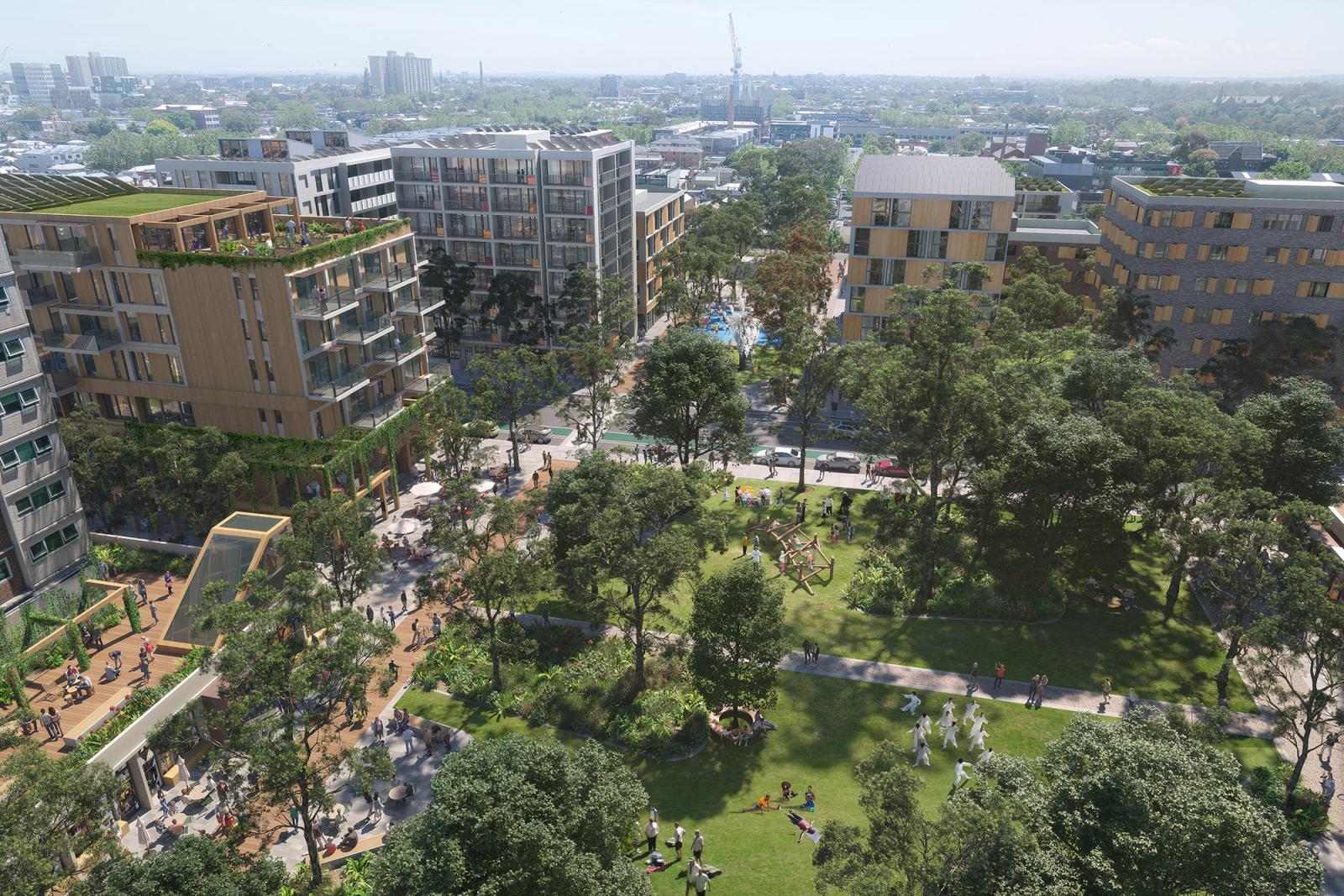
Prior MSG vision of what North Richmond Master Plan + Elizabeth Street bike lanes could look like – please note new Department of Families, Fairness and Housing masterplan consultation is due to start in July 2025.
UPDATE 23 April: So what happened at Yarra Councils Extraordinary Meeting on 22 April 2025?
The second meeting for 22 April 2025: Item 4.1 Elizabeth Street began at 7.19pm after the budget was passed.
Cr McKenzie made a proposed amendment 1: conduct a parking review; as parking is the primary issue. Considerations: parking for the disabled, elderly and drop-offs. A practical and inclusive approach. Sensible approach: Vote 3:6 rejected.
Cr Wade made proposed amendment: 2. let’s consult the community – a significant change that impacts them. Sensible approach: Vote 3:6 rejected.
In summary:
- The bike lanes will be narrowed.
- The buffers will be narrowed.
- The buffers will stay as plastic sticks at intervals, and not be upgraded to safer concrete barriers as recommended by officers.
- There will be no review of parking conditions or community consultation.
- There will be no tree planting, seating added, or beautification works.
What’s next? In short, the City of Yarra needs the Victorian State Government to approve. The Department of Transport and Planning will be asked to sign off on a ‘non-compliant’ less safe bike lane on a Strategic Cycling Corridor, followed by the Minister for Public and Active Transport.
Bicycle Network: Yarra City Council has doubled down on its disturbing decision two weeks ago to reconfigure the Elizabeth Street bike lanes so they do not conform to accepted standards. In an Extraordinary Meeting held on Tuesday 22 April to straighten out the muddled drafting of the key resolution on 8 April, the council repeating its original decision, this time with greater clarity.
Mayor’s unexpected amendment on 8 April 2025
Mayor Jolly’s unexpected amendment to narrow the Elizabeth Street bike lanes in Richmond was a surprise to most members of the public who attended the Yarra Council meeting in good faith on Tuesday 8 April 2025. As you will read, this amendment did not follow the correct council process and has serious repercussions for residents’ confidence in local democracy.
- Take action now: Send an email to the CEO of Yarra, the Minister for Local Government and the Local Government Inspectorate – this link includes serious issues to mention in your email.
- You can watch the livestream of this Extraordinary Council Meeting called for Elizabeth Street at 7.15pm Tuesday 22 April 2025
The motion passed was most similar to “Option 3” in the council officer’s report (an option that included lanes narrower than contemporary guidelines, and which officers recommended against), but was missing a number of crucial elements.
The CEO (who was not present at the 8 April meeting) has subsequently requested that an Extraordinary Council Meeting be held on 22 April 2025 so councillors can vote on Elizabeth Street for a second time due to Mayor Jolly not following correct council process:
This report recommends Council resolve additional items for clarity to be read together with the Council resolution on 8 April 2025. The recommendation below seeks to reflect the understood intent of the previous Council resolution particularly in relation to process, materiality and parking for implementation purposes.EXECUTIVE SUMMARY, 4.1. Elizabeth Street Bike Lane Trial Update (clarification on 8 April resolution)
Community members have been given less than three business days’ notice of the Extraordinary Meeting, with the meeting scheduled to occur just after the Easter long weekend. Notification of the meeting appeared on the meeting page of the council website on 16 April 2025, without people who had made submissions on 8 April being individually notified.
Even if this new motion is passed on 22 April 2025, we think it is lacking some important elements.
See below for a summary of the changes to the bike lanes
As laid out in the officer’s original Option 3 versus version passed on Tuesday versus, the new version proposed below. Note that none of these are recommended by officers (officers recommend Option 1, the current layout of Elizabeth St).
| Option 1 in agenda for 8 April 2025 (recommended by officers) | Option 3 in agenda for 8 April 2025 | Version as passed 8 April 2025 | New version with officer clarifications (for 22 April 2025 meeting) |
| Existing buffer widths retained. | Narrower buffers (0.6 metres wide) between the bike lane and the parking lane along the whole street. | Even narrower buffers (0.5 metres wide) between the bike lane and the parking lane in the western portion of the street. | Same as version passed on 8 April 2025. |
| Parking review of existing parking conditions. | Includes additional parking spaces but does not specifically address community concerns about lack of loading/drop-off zones or need for further disability accessible parking spaces. | No review of parking restrictions in the area or opportunities to include disability accessible bays. | Same as version passed on 8 April 2025. |
| Traffic lane widths retained. | Traffic lane widths reduced. | Traffic lane widths reduced. | Same as version passed on 8 April 2025. |
| Report highlighted bicycle crash incidence at Shelley St (where current layout consists of unprotected bike lanes and poor sightlines due to 4 existing trees). Submitters also raised this issue. Could be addressed as part of permanent design. | Does not address Shelley Street safety issues and will not improve current sightlines at Shelley Street. | Does not address Shelley Street safety issues and will not improve current sightlines at Shelley Street. | Highlights that safety improvements at Shelley Street are excluded from scope, but does not propose that this should be addressed in the permanent design. |
| Stormwater grate can be retained. | The stormwater pit opposite Lewis Court would need to be replaced as narrowing the bike lanes will mean that cyclists can no longer travel around the metal grates on the road surface which are slippery when wet and are on a slight angle tilting towards the gutter. | Does not mention replacing the stormwater grate. | Same as version passed on 8 April. |
| Tree planting in buffers, allowing for large canopy trees. | Option 3 does not include room for tree planting as buffers are too narrow (Option 1 included tree planting in permanent design). | Does not mention tree planting. | Highlights that no tree planting is included in the project |
| Permanent design with concrete buffers to improve current aesthetics and robustness. Some community members raised aesthetics as an issue for the existing layout. | Permanent design with concrete buffers to improve current aesthetics and robustness. | No details as to how new bike lanes would be constructed. Unclear whether proposed changes are temporary or permanent. | Highlights that ‘permanent’ bike lanes will be constructed from plastic bollards (similar to current temporary treatment) due to lower cost. Highlights that 25/26 draft budget has an allowance for bollards but not road resheeting. |
| Most likely option to receive state funding. | Highlights that the state government would be less likely to approve Option 3 and requests an alternative direction should be provided in case approval is not obtained. | Does not mention the need for state government approval. | Highlights that approval from the state government Department of Transport and Planning will be required before the proposed changes to the bike lanes can be made. |
| Community engagement in accordance with council policy | Community engagement in accordance with council policy | No further community engagement or consultation on permanent design, even though it wasn’t presented in advance of submissions on 8 April, and therefore submitters couldn’t address the issues in it. | No further community engagement or consultation on permanent design. No opportunity for community members to speak at the meeting. Previous submitters not notified (as of 16 April 2025) about the extraordinary meeting or the CEO’s recommendation. |
22 April 2025 Extraordinary Council Meeting (7.15pm)
4.1. Elizabeth Street Bike Lane Trial Update (clarification on 8 April resolution)
Executive Summary
On 8 April 2025 Council considered a report in relation to the Elizabeth Street protected bike lanes. This report recommends Council resolve additional items for clarity to be read together with the Council resolution on 8 April 2025. The recommendation below seeks to reflect the understood intent of the previous Council resolution particularly in relation to process, materiality and parking for implementation purposes.
Officer Recommendation
That Council:
- Notes the resolution of Council on 8 April 2025 (Item 7.1 Elizabeth Street Bike Lane Trial Update) and further resolves:
(a) To immediately commence the preparation of final designs for the construction of permanent protected bike lanes on both sides of Elizabeth Street North Richmond for Council approval as soon as possible to show:
(i) Between Lennox and Hoddle St, the new widths will be as follows:
o Bike lane 1.5 meters
o Buffer 0.5 meters
o Parking 2.1 meters
o Traffic lane 2.85 meters
(ii) Between Lennox and Church St, the new widths will be as follows:
o Bike lane 1.7 meters
o Buffer 0.6 meters
o Parking 2.1 meters
o Traffic lane 3 meters
(iii) The reinstatement of as many car parking spaces as possible on both sides of Elizabeth Street and parking management to be comparable to pre-trial conditions; and
(iv) The use of similar infrastructure to existing trial infrastructure i.e. bollards rather than concrete kerbing to reduce costs and speed up delivery;
(b) Notes that tree planting in the corridor and any intersection treatment changes at Shelley Street are not included in the project scope;
(c) To retain the existing Elizabeth Street bike lane trial infrastructure in situ until permanent treatment designs are resolved as noted in Point (a) above;
(d) Following Council approval of the final permanent designs, seeks urgent approval by the Department of Transport and Planning (DTP) to replace the temporary Elizabeth Street bike lane infrastructure currently in place with protected bike lanes as described in point 1 (a) installed on a permanent basis;
(e) Following receipt of DTP consent, commence construction works for the construction of the permanent protected bike lanes on both sides of Elizabeth Street North Richmond as described in Point 1 (a) as soon as possible;
(f) Notes the $200,000 2025/26 budget allocation for Elizabeth Street and receives a further report from Officers outlining the construction costs including road sheeting when the final designs are resolved (noting the intended use of similar infrastructure to existing i.e. bollards rather than concrete kerbing to reduce costs);
and
(g) Maintains Elizabeth Street using patch ups in the interim.
Legal and Legislative obligations
Conflict of interest disclosure
Section 130 of the Local Government Act 2020 requires members of Council staff and persons engaged under contract to provide advice to Council to disclose any conflicts of interest in a matter to which the advice relates. The Officer reviewing this report, having made enquiries with relevant members of staff, reports that no disclosable interests have been raised in relation to this report.
Report attachments
Nil.
- Agenda – Extraordinary Council Meeting 7:15 pm, Tuesday 22 April 2025 Richmond Town Hall (pdf, seven pages)
22 April 2025: Yarra Council Extraordinary Council Meeting Minutes, 7:20 pm, Richmond Town Hall
Council Business Reports
4.1. Elizabeth Street Bike Lane Trial Update (clarification on 8 April resolution)
Author Sue Wilkinson – Chief Executive Officer
Authoriser Chief Executive Officer
Officer Recommendation Start time: 7.21pm
That Council:
- Notes the resolution of Council on 8 April 2025 (Item 7.1 Elizabeth Street Bike Lane Trial Update) and further resolves:
(a) To immediately commence the preparation of final designs for the construction of permanent protected bike lanes on both sides of Elizabeth Street North Richmond for Council approval as soon as possible to show:
(i) Between Lennox and Hoddle St, the new widths will be as follows:
o Bike lane 1.5 meters
o Buffer 0.5 meters
o Parking 2.1 meters
o Traffic lane 2.85 meters
(ii) Between Lennox and Church St, the new widths will be as follows:
o Bike lane 1.7 meters
o Buffer 0.6 meters
o Parking 2.1 meters
o Traffic lane 3 meters
(iii) The reinstatement of as many car parking spaces as possible on both sides of Elizabeth Street and parking management to be comparable to pre-trial conditions; and
(iv) The use of similar infrastructure to existing trial infrastructure i.e. bollards rather than concrete kerbing to reduce costs and speed up delivery;
(b) Notes that tree planting in the corridor and any intersection treatment changes at Shelley Street are not included in the project scope;
(c) To retain the existing Elizabeth Street bike lane trial infrastructure in situ until permanent treatment designs are resolved as noted in Point (a) above;
(d) Following Council approval of the final permanent designs, seeks urgent approval by the Department of Transport and Planning (DTP) to replace the temporary Elizabeth Street bike lane infrastructure currently in place with protected bike lanes
as described in point 1 (a) installed on a permanent basis;
(e) Following receipt of DTP consent, commence construction works for the construction of the permanent protected bike lanes on both sides of Elizabeth Street North Richmond as described in Point 1 (a) as soon as possible;
(f) Notes the $200,000 2025/26 budget allocation for Elizabeth Street and receives a further report from Officers outlining the construction costs including road sheeting when the final designs are resolved (noting the intended use of similar infrastructure to existing i.e. bollards rather than concrete kerbing to reduce costs); and
(g) Maintains Elizabeth Street using patch ups in the interim.
MOTION, Moved: Councillor Jolly Seconded: Councillor Ho
That Council:
- Notes the resolution of Council on 8 April 2025 (Item 7.1 Elizabeth Street Bike Lane Trial Update) and further resolves:
(a) To immediately commence the preparation of final designs for the construction of permanent protected bike lanes on both sides of Elizabeth Street North Richmond for Council approval as soon as possible to show:
(i) Between Lennox and Hoddle St, the new widths will be as follows:
o Bike lane 1.5 metres
o Buffer 0.5 metres
o Parking 2.1 metres
o Traffic lane 2.85 metres
(ii) Between Lennox and Church St, the new widths will be as follows:
o Bike lane 1.7 metres
o Buffer 0.6 metres
o Parking 2.1 metres
o Traffic lane 3 metres
(iii) The reinstatement of as many car parking spaces as possible on both sides of Elizabeth Street and parking management to be comparable to pre-trial conditions; and
(iv) The use of similar infrastructure to existing trial infrastructure i.e. bollards rather than concrete kerbing to reduce costs and speed up delivery;
(b) Notes that tree planting in the corridor and any intersection treatment changes at Shelley Street are not included in the project scope;
(c) To retain the existing Elizabeth Street bike lane trial infrastructure in situ until permanent treatment designs are resolved as noted in Point (a) above;
(d) Following Council approval of the final permanent designs, seeks urgent approval by the Department of Transport and Planning (DTP) to replace the temporary Elizabeth Street bike lane infrastructure currently in place with protected bike lanes as described in point 1 (a) installed on a permanent basis;
(e) Following receipt of DTP consent, commence construction works for the construction of the permanent protected bike lanes on both sides of Elizabeth Street North Richmond as described in Point 1 (a) as soon as possible;
(f) Notes the $200,000 2025/26 budget allocation for Elizabeth Street and receives a further report from Officers outlining the construction costs including road sheeting when the final designs are resolved (noting the intended use of similar infrastructure to existing i.e. bollards rather than concrete kerbing to reduce costs); and
(g) Maintains Elizabeth Street using patch ups in the interim.
AMENDMENT, Moved: Councillor McKenzie Seconded: Councillor Wade
(h) Complete a review of parking restrictions (exploring additional opportunities for parking in the surrounding area).
CALL FOR A DIVISION
For: Councillor McKenzie, Councillor Crossland and Councillor Wade
Against: Councillor Jolly, Councillor Aston, Councillor Davies, Councillor Gomez, Councillor
Harrison and Councillor Ho
Lost
AMENDMENT, Moved: Councillor Wade Seconded: Councillor Crossland
That Council:
- Notes the resolution of Council on 8 April 2025 (Item 7.1 Elizabeth Street Bike Lane Trial
Update) and further resolves:
(a) To immediately commence the preparation of final concept designs for the construction of permanent protected bike lanes on both sides of Elizabeth Street North Richmond for Council approval consideration for release for community consultation as soon as possible to show:
CALL FOR A DIVISION
For: Councillor McKenzie, Councillor Crossland and Councillor Wade
Against: Councillor Jolly, Councillor Aston, Councillor Davies, Councillor Gomez, Councillor Harrison and Councillor Ho
Lost
COUNCIL RESOLUTION, Moved: Councillor Jolly Seconded: Councillor Ho
That Council:
- Notes the resolution of Council on 8 April 2025 (Item 7.1 Elizabeth Street Bike Lane Trial Update) and further resolves:
(a) To immediately commence the preparation of final designs for the construction of permanent protected bike lanes on both sides of Elizabeth Street North Richmond for Council approval as soon as possible to show:
(i) Between Lennox and Hoddle St, the new widths will be as follows:
o Bike lane 1.5 meters
o Buffer 0.5 meters
o Parking 2.1 meters
o Traffic lane 2.85 meters
(ii) Between Lennox and Church St, the new widths will be as follows:
o Bike lane 1.7 meters
o Buffer 0.6 meters
o Parking 2.1 meters
o Traffic lane 3 meters
(iii) The reinstatement of as many car parking spaces as possible on both sides of Elizabeth Street and parking management to be comparable to pre-trial conditions; and
(iv) The use of similar infrastructure to existing trial infrastructure i.e. bollards rather than concrete kerbing to reduce costs and speed up delivery;
(b) Notes that tree planting in the corridor and any intersection treatment changes at Shelley Street are not included in the project scope;
(c) To retain the existing Elizabeth Street bike lane trial infrastructure in situ until permanent treatment designs are resolved as noted in Point (a) above;
(d) Following Council approval of the final permanent designs, seeks urgent approval by the Department of Transport and Planning (DTP) to replace the temporary Elizabeth Street bike lane infrastructure currently in place with protected bike lanes as described in point 1 (a) installed on a permanent basis;
(e) Following receipt of DTP consent, commence construction works for the construction of the permanent protected bike lanes on both sides of Elizabeth Street North Richmond as described in Point 1 (a) as soon as possible;
(f) Notes the $200,000 2025/26 budget allocation for Elizabeth Street and receives a further report from Officers outlining the construction costs including road sheeting when the final designs are resolved (noting the intended use of similar infrastructure to existing i.e. bollards rather than concrete kerbing to reduce costs);
and
(g) Maintains Elizabeth Street using patch ups in the interim.
CALL FOR A DIVISION
For: Councillor Jolly, Councillor Aston, Councillor Davies, Councillor Gomez, Councillor Harrison and Councillor Ho
Against: Councillor McKenzie, Councillor Crossland and Councillor Wade
Carried
5 June 2025: Parliament of Victoria: Inquiry into the 2025-26 budget estimates, Elizabeth Street Question on Notice to The Hon Gabrielle Williams
On 5 June 2025, at the Inquiry into the 2025-26 budget estimates public hearings, Aiv Puglielli MLC asked The Hon Gabrielle Williams MP about Elizabeth Street in North Richmond. Her response to this question on notice can be read on page 4. (pdf, four pages)
Question: On another matter, Elizabeth Street in North Richmond has been named by the department as a priority strategic cycling corridor, but we have just seen Yarra City Council vote to narrow the bike lanes and reinstate parking on the north side of the street, putting cyclists at risk, effectively. Can I ask: does the government intend to block Yarra’s decision on this matter?
Answer: Elizabeth Street is a local road under the management of the City of Yarra. The Department of Transport and Planning (DTP) has advised that they do not support the downgrading of important cycling corridors, such as the one provided in Elizabeth Street. DTP acknowledges that the Council’s decision was a result of local community feedback and debate, and will continue to work closely with Council to ensure any new design meets the relevant standards and requirements.
15 July 2025: Newly released plans for Elizabeth Street, released under Freedom of Information
Streets Alive Yarra: Something for everyone on Elizabeth Street: There’s something for everyone in newly released plans for Elizabeth Street, released under Freedom of Information, including car parking on the north side of the street. For context, there are two different plans for Elizabeth Street:
December 2024 – plans prepared in response to the April 2023 resolution to make the bike lanes permanent, now released under Freedom of Information protected bike lanes using permanent infrastructure parking alternating between the north and south sides of the street
August 2025 – plans prepared in response to the April 2025 resolution to narrow the bike lanes, scheduled to be published in August, for Council to endorse to send to the state government Department of Transport and Planning (DTP) for approval protected bike lanes and buffers drastically narrowed parking on both sides of the street.
The ‘December 2024’ plans were prepared as a corridor study funded by the previous Council in the 2024/25 budget. The work was done, but the designs were kept secret…until now!
- Released under Freedom of Information Request – Yarra City Council: Elizabeth Street, Richmond North Protected Bike Lanes (pdf, 16 pages)
7 August 2025: Future of North Richmond – People, Bikes, Cars and Housing
Listen back to two presentations from the forum: Future of North Richmond – People, Bikes, Cars and Housing forum (11 August 2025)
Future of North Richmond – People, Bikes, Cars and Housing: come to a forum of community members to discuss what we want Elizabeth Street and the North Richmond precinct to look like in 10-20 years.
8 August 2025: Bicycle Network: Yarra to persist with sub-standard bike lane plan
Despite a report from the administration highlighting the risks of proceeding with the unorthodox concept, the council voted 6-2 in favour.
The temporary lanes now in place will remain while the city attempts to develop a detailed design that meets Mayor Stephen Jolly’s requirements at the same time as it ignores standards such as lane width and sightlines.
Those plans then must be approved by the Department of Transport and Planning, which typically has high standards for safety.
In comments since devising the concept of narrow bike lanes Mr Jolly has justified the move as enabling him to provide additional car parking for visitors to the Vietnamese Buddhist temple in the street.
So far this year the decision-making on what should have been a straightforward adoption of established and standardised bike lane designs has been fumbled badly, embarrassing a city which was once a pioneering leader in the development of active travel infrastructure in Australia.
At their meeting in April the council adopted a suggestion from Mayor Stephen Jolly that the bike lanes in one section be just 1.5m wide.
Documents recently released following Freedom of Information requests indicate that key decisions on this matter were committed to by some councillors prior to, and without consideration of, advice and recommendations being provided by the council administration.
Tuesday council meeting was critical as the council meeting papers now released contain comprehensive details on several options for the bike lane designs, together with the implications of trying to reduce road safety in order to gain extra parking in a street where existing parking is underutilised.
Elizabeth Street is a designated Strategic Cycling Corridor, recognition of its future importance as a key route into Melbourne’s city centre from the inner east.
It connects to Albert Street through the City of Melbourne linking to other important north–south bike corridors through the inner city. Albert Street was one of Melbourne’s earlier separated bike infrastructure streets, once controversial, but now accepted.
Furthermore, Elizabeth Street has had temporary separated bike lanes for an extended period since 2020 and evaluations have shown them to be successful with no negative outcomes for the surrounding neighbourhoods.
The officers’ report to the council contains concept designs that respond to the council’s earlier request for narrowed lanes, but it also highlights the numerous pitfalls lying in wait for the ill-conceived proposal.
It includes a Road Safety Audit which draws attention to the fact that adding back car parking into the design would trigger multiple issues with sightline requirements, resulting in unsafe conditions for road users. In effect the council would have narrowed the bike lanes in order to put back car parking that they then have to take out again because of safety concerns.
There is also a substantial risk that the Department of Transport and Planning will determine that the proposal is unsatisfactory and ask for changes. Theoretically, the council could proceed without such approvals, but such a move would ring alarm bells in Spring Street.
And then there are the council’s insurers, the MAV Liability Mutual Insurance scheme. This is a not-for-profit scheme comprising other Melbourne councils, including those who build their bike lanes to recognised standards so that they will not face the liability claims that the City of Yarra is now inviting with its non-compliant design proposal.
Bicycle Network, speaking from many years of experience in the planning, design and delivery of bike infrastructure, would never advise any road authority to build a separated lane this narrow.
The rider has a gutter on their left which is not considered to be “rideable space”, so your 1.5m bike lane is not even that wide to begin with. And on the rider’s right is a barrier kerb which riders never ride close to because of risk of pedal strike, so the rideable area is narrowed again.
Victoria has several decades of experience with separated bike lanes and there is pretty much universal agreement that lanes should be 2m wide, with 1.8m the minimum acceptable.
Yarra Council Ordinary Council Meeting, 6:30 pm, Tuesday 12 August 2025, Richmond Town Hall
Yarra Council votes for Option 4 with amendment: Approval of baseline concept design plan with the amount of car parking returned reflecting all high- and medium-risk recommendations from the RSA, noting that optional additional street features could be added to this option.
Note: As Department of Transport and Planning approval is required and future North Richmond redevelopment plans are imminent, the Elizabeth Street protected lanes issue is far from over at this point of time. Yarra Council are only redesigning the existing temporary barriers that have been in situ since 2020, not the final designs.
Yarra Council Agenda,12 August 2025: 7.1. Elizabeth Street Concept Plans: refer to pages 8-63
Extract: 7.1. Elizabeth Street Concept Plans (pages 8 – 15)
Attachment 7.1.1 Council Resolution (page 16 – 18)
Attachment 7.1.2: Road Safety Audit – Elizabeth Street, Richmond (pages 19 – 45)
Attachment 7.1.3: Elizabeth Street Narrowed Protected Bike Lanes Concept Design FINAL July 2025 (pages 46 – 60)
Attachment 7.1.4: Hoddle Street Extension (pages 61 – 62)
The Age: Richmond bike lanes to shrink after controversial parking plan approved (12 August 2025)
‘Clarification—A previous version of this story stated the council was Greens-led at the time of the original implementation of the trial. This was incorrect. The implementation began before the council elected a Greens mayor in 2020. The story has been amended to reflect this.’
13 January 2026: Herschel Landes of Richmond: Breaking news – Victorian Government bails out of the Elizabeth St bike lane decision with DTP leaving the matter to the local Council
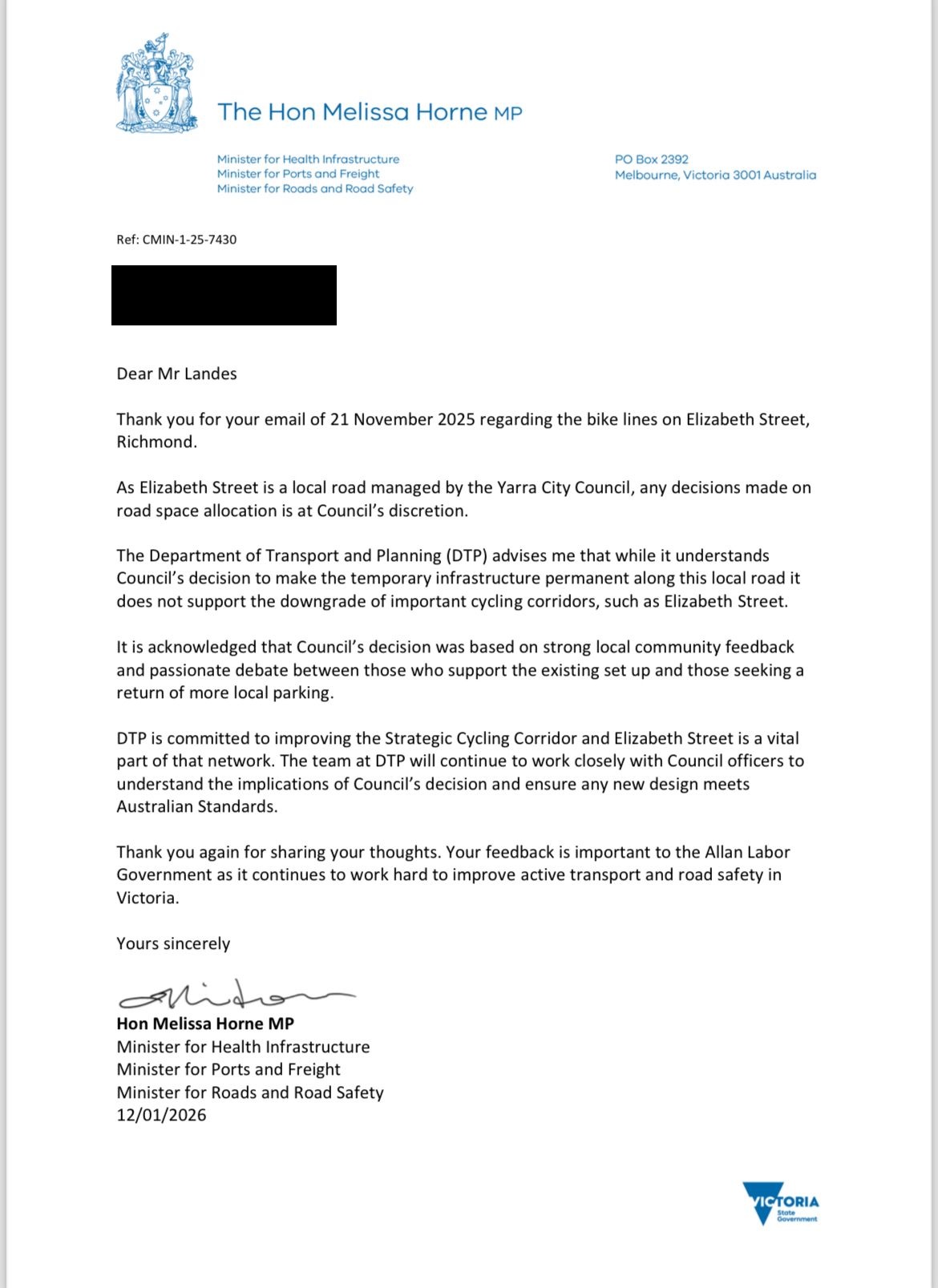
The Minister has the power to act in the public interest but it seems that in the case of Elizabeth St, such an intervention has been deemed not to be warranted . The letter acknowledges that strong community feedback includes this who support the existing setup.
The irony is that Council’s Advocacy roadmap that is seeking $86M for various projects, including securing State Government approvals and funding for Council’s priority bike lanes: Elizabeth St, Langridge Street, Gipps Street, Coppin Street and Wellington St !! Goodluck with that.
This backwards Council has a view that road allocation towards static parking is a winner when it comes to popular support. It is a promise that is impossible to achieve. Roads are not magic puddings and there is only finite capacity to deliver parking outcomes in growing populations. Investing in alternative transport options to divert road allocation away from parking should be Council’s priority. Sadly it is not.”
Yarra Council Agenda for Ordinary Council Meeting, 6:30 pm, Tuesday 10 February 2026, Fitzroy Town Hall
Confusing messaging from council with Quarterly Community Report 2025/26, have the state government requirements been ‘resolved’ as a conflicting report further in agenda states ‘These have been submitted to State Government for approval. Once approved, the project will move into delivery phase‘
There is no argument that the Elizabeth Street surface is badly degraded but resurfacing the entire road before State Governments/Homes Victoria plans for North Richmond are known, is a potential waste of rate payers money as future redevelopment works will greatly impact the streets condition.
So in summary, Yarra are now planning to spend $720,000 to make a key cycling corridor WORSE.
- Council Business Reports – 7.1. Quarterly Community Report 2025/26 Quarter 2 (page 10)
- Actions reported as ‘Off track’ are:
Building the City
2.1.1.1 Progress New Deal for Cycling corridor projects
Status: Off track – Pending State Government approval of concept plans for the Elizabeth Street corridor. (note State requirements have now been resolved (Jan 2026), and project will now progress to tender).
Table 4. Recommended reallocation of capita funds (Page 14)
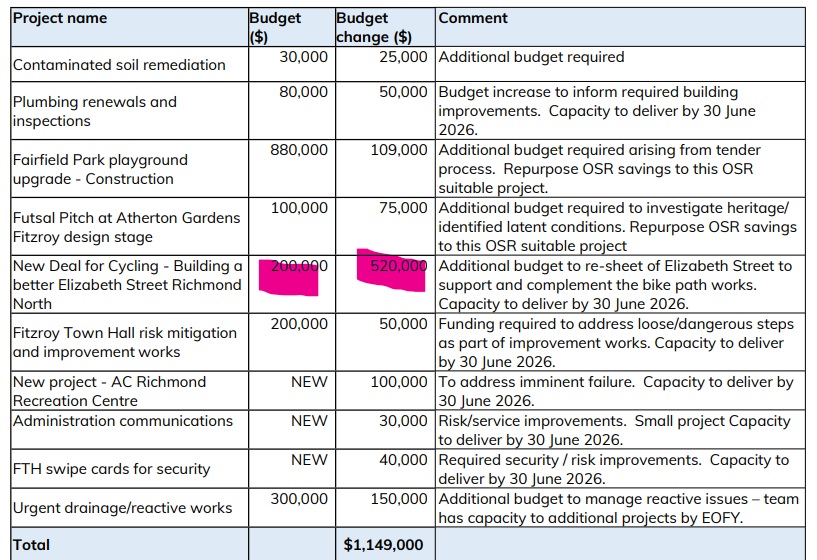
2 Building the City (page 70)
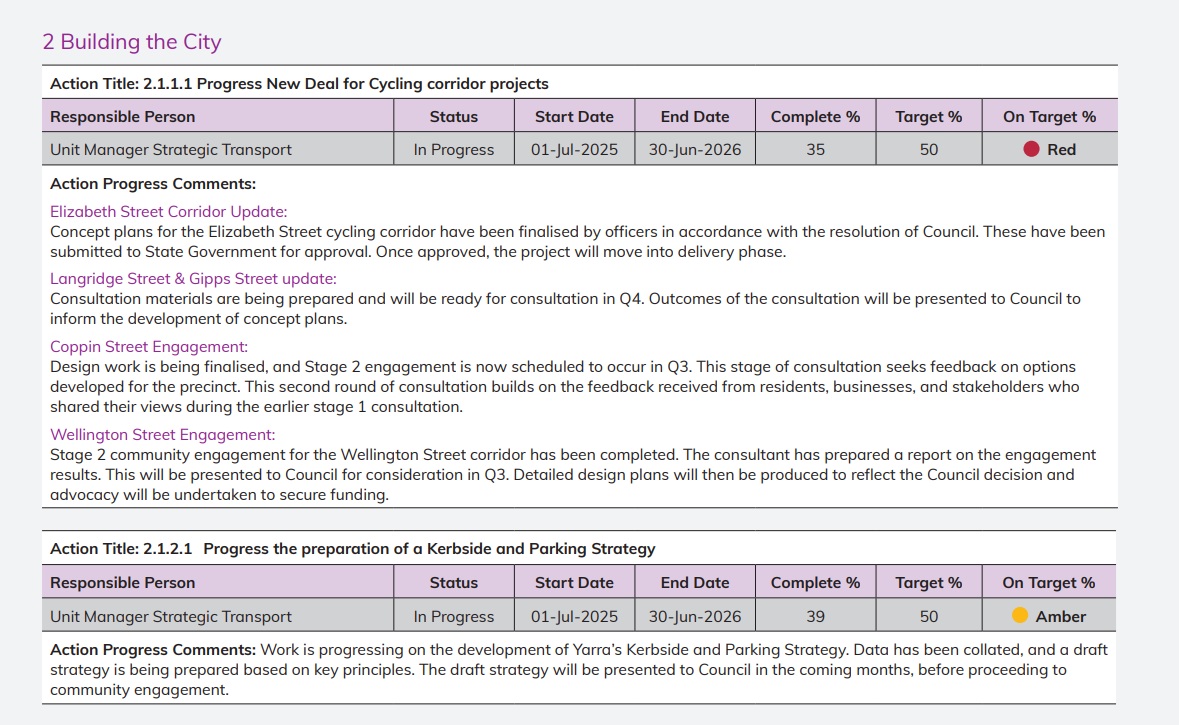
8 February 2026: Request to protect Strategic Cycling Corridor from degradation
February 2026
Request to protect Strategic Cycling Corridor from degradation
Dear Minister Williams,
We note the following Victoria Planning Provision:
- 18.01-1S Protect existing and facilitate new walking and cycling access to public transport.
We note the Transport Integration Act vision statement, transport system objectives, and requirement:
- 64B (b) to manage…the road system…by seeking to increase the share of public transport, walking and cycling trips as a proportion of all transport trips.
And refer you to the agenda for the 10th February 2026 meeting of Yarra City Council, wherein it is proposed to degrade the existing bicycle lanes on Elizabeth Street, which form part of Melbourne’s Strategic Cycling Corridors. The agenda suggests that the plans have been ‘resolved’ and the project will now progress to tender.
We ask you to step in and halt the degradation of these lanes.
We suggest that one way to do this would be to publish statutory guidelines for the design of bicycle lanes along Strategic Cycling Corridors, such as by adopting The Cycling Guide, which is part of a set of Movement and Place Guides commissioned by the state government; and then require the City of Yarra to comply with those guidelines.
Yours sincerely,
Yarra Bicycle Users Group
Streets Alive Yarra
- https://www.yarracity.vic.gov.au/sites/default/files/2026-02/ordinary_council_meeting_agenda_-_tuesday_10_february_2026.pdf
- https://streets-alive-yarra.org/journal/movement-and-place-guides/
Additional background:
- Streets Alive Yarra: Update February 2026
- Elizabeth Street Protected Bike Lanes: A history (1993 – 2019) – Part 1
- Elizabeth Street Protected Bike Lanes: A history (2020 – 2023) – Part 2
- Elizabeth Street Protected Bike Lanes: A history (2024 – 2026) – Part 3
Elizabeth Street protected bike lanes downgrade to start Monday 16 March 2026
It’s been brought to our attention that Elizabeth Street ‘works’ to narrow the existing protected lanes are to commence Monday 16 March 2026.
We need YOUR HELP to contact the Ministers to save Richmond’s best bike lanes!
What you can do right now
- Send a email to Melissa Horne.
- Download and display A4 leaflet.
- Contact us and talk to your neighbours and contacts!
At time of publishing this post, there is NO signage in-situ along Elizabeth Street, Richmond or any online communication that informs both residents and riders to these immediate changes.
This is dangerous and a total failure of Yarra Council’s duty of care to residents and visitors alike.
As you can read below, the communication from Yarra Council is extremely poor, there is no mention of detours for riders let alone these ‘works’ being a possible breach of breach of the Road Management Act and a fundamental disavowing of the Strategic Cycling Network.
Background
- Request to protect Strategic Cycling Corridor from degradation
- Elizabeth Street Protected Bike Lanes: A history
- Our petition “Don’t risk our safety in 2025 – tell Yarra Council not to remove safe cycling lanes” has received over 1100 responses!
Extracted text: Page 1: City of Yarra. Notice of works. Elizabeth Street, Richmond Road Pavement Works
We will be carrying out works in your neighborhood soon and would like to share some important information.
What are we doing?
– Resurface the road pavement.
– Reconstruction of road humps.
– Relocating current the bike lane bollards.
When will the work take place? The works are scheduled to commence on Monday 16 March 2026. Works are expected to take 4 to 5 weeks to complete, subject to weather conditions.
Where are the works happening?
The works are happening in Elizabeth Street, from Hoddle Street to Church Street, Richmond -as shown on the map below.
Page 2: Working hours 7am to 6pm during weekdays 9am to 3pm on Saturdays (if required) Resurfacing works 6pm to 5am (night works) During the overnight works, cars will not be able to park along Elizabeth Street but will be able to park there during the day. There may be some noise and dust during the works, but we will try to keep this to a minimum.
Will I be able to access the street?
The preliminary works will commence on Monday 16 March 2026. Sections of the road under reconstruction will be closed to vehicles during pavement resurfacing night works (6:00 pm to 5:00 am) between 25 March 2026 and Tuesday 31 March 2026.
An appropriate traffic management plan will be in place with suitable detours. Pedestrian access along the street and vehicle access for local residents will be maintained with the assistance of traffic controllers onsite.
Full road access to traffic will resume after 5:00 am each day. Please consult with our contractor if you require assistance with access.
Where do I park my car?
Parking will not be permitted in the works zone in Elizabeth Street during resurfacing working hours from 6:00 pm to 5:00 am between 25 March 2026 and Tuesday 31 March 2026. If you require a temporary permit during the period of works, please follow the instructions below:
1. Visit the following site www.yarracity.vic.gov.au/all-online-requests
2. Under Parking’ Select ‘General Parking Permit Enquiry
3. Complete the form including your address and phone number
4. Please also include vehicle: registration number; make; and model.
5. Attach a copy of this notice.
Page 3: Please note that vehicles parked in the works zone during works hours will be towed.
Why is Council undertaking the re-sheeting of the road as part of these works?
On advice from officers, Council decided to conduct the re-sheeting of the road during these works to:
Minimise disruption to residents and businesses Improve the quality of the road
Complete the works on Elizabeth Street as soon as possible.
What did Council decide and when?
Council decided to maintain and extend the protected bike route on Elizabeth Street while also restoring 48 car spaces.
This incorporated all the high and medium-risk recommendations including the sightline requirements from the Road Safety Audit. Council endorsed the baseline Concept Design plan for the Elizabeth Street Cycling Corridor at the Council Meeting on 10 February, 2026.
Will you be removing car parks? These works will restore 48 car parks on Elizabeth Street, while ensuring protected bike lanes operate in both directions.
Page 4: What will happen to the bike lane?
The existing bike lanes will remain in both directions, with bollards to protect bike riders from traffic The bike lanes will be reduced in width to allow for the return of 48 car parking spaces along Elizabeth Street.
Are you doing anything else as part of these works?
Speed cushions will be installed for cyclists on Little Hoddle Street and Regent Street, and a contraflow bike lane on Jonas Street. Cyclists will also benefit from a bike-friendly grated drain cover which will be safer for cyclists to ride over.
Contractor – Bosco Civil Claud Bosco – 0411 100 817
Contractor – RABS Group Clinton Shewan – 0402 668 262
Or email us on info@yarracity.vic.gov.au
16 March 2026: The Age: Bobcat and protesters take to Richmond bike corridor being narrowed for car spaces
Tempers flared in North Richmond on Monday morning as cyclists gathered to protest a controversial move to narrow bike lanes on a main thoroughfare and reintroduce 48 car parking spaces.
The project, described by the City of Yarra council as a “glow-up”, involves road resurfacing and the relocation of existing bike lane bollards between Hoddle and Church streets.
The work marks the end of a five-year trial of wide, protected lanes that have become a focal point of local political division.
Mayor Stephen Jolly defended the works on Monday, saying the current infrastructure was a “bike superhighway that’s not used that much”.
“It’s about sharing and not listening to just one interest group,” Jolly said. “These changes will make the bike lane the same width it is on Albert Street that it continues from, while allowing locals better access to their Buddhist Temple, homes and businesses and also get some parking back.” “Everyone will now get a share of the street, not just one group,” he said.
Bicycle Network, the nation’s largest rider organisation, had been urgently requesting state intervention from Roads Minister Melissa Horne to halt the works, but on Monday council contractors began tearing up protective barriers along the strip.
Cyclists and supporters – including the Greens – claim the new design, which reduces riding space to approximately 1.5 metres, including gutters, is “far too narrow” and fails to meet safety standards for a “strategic cycling corridor” into the CBD that is used by thousands of riders weekly.
“The City of Yarra once regarded itself as a leader in the design and delivery of bike lanes, but sadly, it has lost its way,” Bicycle Network chief executive Alison McCormack said.
The council’s “Yarra For All” independent bloc, led by Jolly, approved the plan last year following a highly charged debate in which the mayor labelled complaints from safety advocates a sense of “white privilege” as many complaints about the loss of carparking came from attendees of the Buddhist Temple on the strip. The temple has since been demolished and is being redeveloped.
A number of protestors opposed to the downgrade – including Greens Richmond MP Gabrielle de Vietri and Greens councillor Sophie Wade – attended the site this morning with placards.
While an independent road safety audit commissioned by the council warned that reinstalling the car parks posed a “significant risk” due to dangerously reduced sight lines for drivers, a majority of councillors voted to proceed with the narrowed design.
Wade and Deputy Mayor Sarah McKenzie, who is now Labor’s nominated candidate for the seat of Richmond in the November state election, opposed the plan, with McKenzie citing personal safety concerns after recently being hit by a car while cycling nearby.
“I stand by my vote. Safer bike lanes get more people cycling,” she said. “Narrowing them makes it harder to move through our increasingly dense area. Hundreds of locals wrote to me asking that they be kept as they are.”
But despite this, McKenzie aligned with the state government’s position that the final authority rests with local officials. “It’s appropriate the decision is made by council,” she said.
The Allan government has distanced itself from the dispute, despite a letter seen by The Age which indicated the Department of Transport and Planning had expressed a lack of support for the downgrade.
A Victorian government spokesperson said Elizabeth Street is a council-managed road and “decisions about the design of the bike lanes sit with Yarra City Council”.
“We understand Yarra City Council’s decision will be disappointing for some members of the community, and we encourage anyone concerned about the designs to raise it directly with council,” the spokesperson said.
Under current legislation, the state’s role is limited to ensuring designs meet Australian standards; it cannot direct a council to change a design if those minimum requirements are met.
Works are scheduled to continue for four to five weeks, with night road closures in place between 6pm and 5am from March 25 to March 31.
17 March 2026: Media Release – Yarra Council Rips Up Bike Lanes – “Road Safety” Minister Lets It Happen
Strategic Cycling Network Design Guidelines Ignored
Residents and cyclists in North Richmond want to get around their community safely, and they have been writing emails – hundreds of them – asking the Minister for Road Safety, Melissa Horne, and the Minister for Active Transport, Gabrielle Williams, to intervene in a local dispute that will see bicycle lanes in Elizabeth Street, Richmond, narrowed to make way for 45 additional car parking spaces as part of road resheeting works that commenced on Monday, 16th March 2026.
With no action to stop the works from the state government, residents and bike riders were on site on Monday as workers levered up the yellow traffic separators, leaving people on bikes, e-bikes, and e-scooters with no protection from cars for the next four to five weeks and exposing people on bikes to close passes and near-dooring, in a risk to Yarra Council’s public liability.
The residents argue that narrower lanes and the associated narrow traffic “buffers” will put people on bikes into gutters and increase the danger of dooring. Narrower lanes will make traveling difficult for cargo bikes and delivery workers. Residents also requested that the ministers enforce the minimum design guidelines for Strategic Cycling Corridors (SCC), which recommend a minimum width of 2.0 m for protected bike lanes on streets like Elizabeth St.
As a major east-west cycling route into Melbourne’s CBD, the SCC along Elizabeth St. connects to Albert St. in the City of Melbourne. Elizabeth St. is a local road under the control of the local Yarra Council. The existing Albert St. protected lanes are due to be upgraded and widened in 2026-27.
The Elizabeth St. protected lanes in North Richmond were designed and trialed in 2020 and made permanent in 2023. On 8 April 2025, a new councillor group voted to drastically narrow the protected lanes so as to be able to add car parking to the north side of the street. A second vote, on 22 April 2025, was held to clarify the motion after the CEO raised governance issues with the original motion.
At a third vote on 12 August 2025, councillors ignored concerns raised in a Road Safety Audit report for the preliminary design. A fourth vote in 12 February 2026 saw councillors vote for an extra $520,000 for Elizabeth St to be resurfaced, bringing the total cost to downgrade Elizabeth St. protected lanes to $720,000. A cost of $16,000 per car parking space.
Quote attributable to Karen Hovenga:
As a local, I support these lanes and at a time when many people are facing uncertainty due to possible petrol shortages, the Victoria State government shouldn’t allow local councils to play short-term politics and remove safe alternative travel options and waste ratepayers money.
Quote attributable to Herschel Landes:
Streets Alive Yarra obtained The Cycling Guide under FOI in 2022, after it was “soft launched” by the state government in 2020 and sent to local councils and transport consultants. These minimum design guidelines have never been made mandatory, and local streets, even those which are Strategic Cycling Corridors, are at the mercy of local politics and influence.
Quote attributable to Yarra Councillor Sophie Wade:
Labor has stood by while Yarra Council rips up safe bike lanes. Residents deserve safe and affordable options in Richmond, as they were promised. Instead they’ve been abandoned completely by Yarra Council and the Labor government.
Read more:
- Elizabeth Street protected bike lanes downgrade to start Monday 16 March 2026
- Elizabeth Street Protected Bike Lanes: A history 1993 – 2026
- Strategic Cycling Corridors in Victoria
- The Cycling Guide: was obtained under Freedom of Information in 2022. It’s been sitting on the Minister’s desk since 2020. It’s time for the state to adopt it.
17 March 2026: ‘Used to be the most progressive’: Yarra Council begins narrowing bike lanes to make room for car spaces
News.com.au: An inner-city Melbourne council has been accused of abandoning its ‘progressive’ street cred as it begins bulldozing bike lanes for a controversial reason.
An inner-city Melbourne council has been accused of abandoning its “progressive” street cred as it begins bulldozing bike lanes to make way for more carparking spaces.
The City of Yarra on Monday began a controversial works program that will see the bicycle lanes on Elizabeth Street in Richmond narrowed while restoring 45 parking spots.
An inner-city Melbourne council has been accused of abandoning its “progressive” street cred as it begins bulldozing bike lanes to make way for more carparking spaces.
The City of Yarra on Monday began a controversial works program that will see the bicycle lanes on Elizabeth Street in Richmond narrowed while restoring 45 parking spots.
Greens Councillor and former Yarra Mayor Sophie Wade shared footage of the yellow plastic safety bollards being bulldozed on Monday morning with the text, “Yarra used to be the most progressive local government in Australia. Now it’s ripping up bike lanes to put in more parking.”
Yarra Council last year approved the plan to restore the Elizabeth Street carparking — which will see the bike lanes narrowed by 60cm — while an alternate proposal to keep the existing lanes with permanent, concrete buffers was defeated.
“Hard to believe I was once the Mayor of this council,” Cr Wade wrote in the caption.
“I don’t recognise it. Nor do so many locals I spoke to this morning. ‘What? Why is this happening? We don’t need more carparking!’”
Cr Wade interviewed a number of locals who said they did not want to see the bike lanes narrowed, warning of the risk of being hit by car doors or forced into traffic.
“I’m a local, I live really close,” one woman said.
“I use the bike lane daily, very frequently. It makes me feel safe. I think replacing it with something where I can get doored is really just making my life less safe, exposing me to more injuries and I’m really disappointed that the council want to spend money on degrading the really core infrastructure we need here for us to get around … it’s unbelievable.”
Cr Wade’s clip attracted thousands of comments debating the change.
“Unfortunately, a small group of loud voices, often people who don’t even live in the area, seem to be having an outsized influence on local council decisions,” one person replied.
“Many residents here are busy working professionals who don’t have the time to show up to council meetings, yet their voices should matter just as much.”
Another wrote, “Lol at people celebrating this while watching petrol prices skyrocket. Good stuff.”
A third said, “God Australia is embarrassing.”
But others said they supported council’s decision.
“It’s quite clear that the amount of people who use it don’t justify them,” one wrote.
“About time the world comes to its senses,” another said.
“Good get rid of them and push speed limits back up,” a third suggested.
The City of Yarra has been contacted for comment.
In a media release last week, the council said the works program to resurface the road pavement, reconstruct road humps and relocate existing bike lane bollards along Elizabeth Street would run for an estimated four to five weeks, subject to weather conditions.
“Works are being undertaken to improve road quality, reduce disruption for residents and businesses, and complete upgrades on Elizabeth Street as quickly as possible,” the council said.
“The works form part of council’s broader plans for the Elizabeth Street Cycling Corridor, endorsed at its February meeting, where it agreed to maintain and extend the protected bike route while restoring 45 carparking spaces.
“Council says undertaking the road re-sheeting as part of these works will help minimise disruption to residents and businesses, improve road quality and complete works on Elizabeth Street as soon as possible.
“Additional works also include speed cushions on Little Hoddle Street and Regent Street, a contraflow bike lane on Jonas Street, and installation of a bike-friendly grated drain cover.
“Night resurfacing works are expected to take place between March 25 and March 31, 2026, during which sections of the road will be closed to vehicles overnight. Pedestrian access and local vehicle access will be maintained with traffic management in place.”
18 March 2026: Inner City News: Cyclists protest Yarra’s Elizabeth St bike lane downgrade in Richmond
Cycling advocates and local residents gathered on Elizabeth St in Richmond on Sunday, March 15 to protest the City of Yarra’s decision to narrow the street’s protected bike lanes, warning the move will make one of inner Melbourne’s key east-west cycling links less safe.
The protest came just a day before works began to remove the existing separators as part of road resurfacing and redesign works that will reduce the width of the lanes in order to reinstate 45 car parking spaces along the street.
For riders, the issue reaches beyond Richmond. Elizabeth St forms part of a major cycling corridor connecting through Hoddle St to Albert St in East Melbourne and on to the CBD, making it an important link into the City of Melbourne’s broader bike network.
Advocates say narrowing the lanes undermines the role of the route as a Strategic Cycling Corridor and risks creating a weaker connection just as the City of Melbourne prepares to upgrade and widen the Albert St protected lanes in 2026-27.
In a media release issued after the protest, campaigners said residents had sent hundreds of emails to Roads and Road Safety Minister Melissa Horne and Minister for Public and Active Transport Gabrielle Williams, urging them to intervene and stop the changes.
With no action taken by the state government, protesters returned to the street as works commenced on Monday, March 16, as crews began removing the yellow traffic separators protecting the current lanes.
The Yarra Bicycle Users Group said riders using bicycles, e-bikes and e-scooters would now be left without protection from traffic for the next four to five weeks during construction.
Critics argue the narrower lanes and reduced buffers will increase the risk of close passes and dooring, particularly for people riding larger bicycles such as cargo bikes, as well as delivery riders who rely on the corridor daily.
Local resident Karen Hovenga said the timing of the downgrade was particularly concerning.
Campaigners have also argued that Yarra’s redesign falls short of state design guidance for Strategic Cycling Corridors, which recommends a minimum rideable width of two metres for protected bike lanes on streets such as Elizabeth St.
The existing lanes were first trialled in 2020 and made permanent in 2023. But after a change in the makeup of council, councillors voted in April last year to pursue a redesign that would make room for more parking on the north side of the street.
The issue has remained contentious ever since.
As previously reported by Inner City News, councillors voted in August 2025 to proceed with concept designs narrowing the lanes, despite concerns from cycling groups, transport experts and some councillors that the change would make the route less safe and potentially compromise a state-significant corridor.
The council later approved additional funding in February this year for resurfacing works, bringing the reported total cost of the project to $720,000.
Supporters of the existing bike lanes say the money is being spent to make the corridor worse.
Streets Alive Yarra’s Herschel Landes said the controversy exposed a broader problem with cycling infrastructure standards.
“These minimum design guidelines have never been made mandatory, and local streets, even those which are Strategic Cycling Corridors, are at the mercy of local politics and influence,” he said.
Greens councillor Sophie Wade, who has opposed the changes, said residents had been let down.
“Labor has stood by while Yarra Council rips up safe bike lanes,” Cr Wade said. “Residents deserve safe and affordable options in Richmond, as they were promised.”
The City of Yarra has previously argued the redesign is intended to balance cycling access with local parking needs.
Photos: Hanna Komissarova.
19 March 2026: Drive.com.au – ‘Back to the people’: Cyclists outraged after introduction of new car parks
Cyclists and other advocates – including one Greens MP – are fighting an inner-Melbourne council after it reduced the size of bike lanes to make room for more than 40 on-street parking spaces.
A local council in Melbourne has found itself in a dispute with residents after cyclists and other advocates protested the reduction of bike lanes to reintroduce more than 40 on-street parking spaces.
Yarra Council – which governs North Richmond, an inner-city suburb in Melbourne – has started renovating the road along Elizabeth Street in Richmond on 16 March 2026.
The roadworks – expected to be completed within four to five weeks – will reduce the width of the bike lanes to 1.5m, including gutters, to make room for 45 car park spaces along the street.
Mayor Stephen Jolly visited the site on Monday and defended the council’s decision, stating the street has been “a superhighway for cyclists”, with local community members urging authorities to make room for more on-street parking.
“It means that people in this area will be able to access their temple, their homes, their businesses. There’ll be a little bit of an increase in parking, and we’ll have a street once again that’s shared by everybody,” Mayor Jolly said in a social media video posted to Facebook in March 2026.
“We don’t just listen to one interest group. We listen to everybody. We’re bringing Elizabeth Street back to the people.”
A Yarra City Council spokesperson confirmed it will not charge for these car parks.
“Council has not proposed to charge for these parking spaces, which were lost when the temporary [bike] lanes were installed in 2020,” a Yarra City Council spokesperson told Drive.
However, cycling advocates – including one Greens MP – have slammed the council’s decision over safety and travel concerns.
According to a 16 March 2026 report by The Age, some cyclists gathered to protest the roadworks, with Bicycle Network – Australia’s largest rider organisation – previously requesting urgent state intervention from Roads Minister Melissa Horne to postpone the work.
“The City of Yarra once regarded itself as a leader in the design and delivery of bike lanes, but sadly, it has lost its way,” Bicycle Network Chief Executive Alison McCormack told the masthead.
Greens Richmond MP Gabrielle de Vietri was among the number of protesters who gathered at the work site.
In a March 2026 media statement, de Vietri condemned the council’s decision, stating it would cause further financial pressure due to the lack of cheaper transport alternatives.
“Fuel prices are soaring and people are desperate to find cheaper ways to travel around … the last thing we should be doing at a time like this is making it harder to get around using one of the cheapest ways to travel,” she said.
“Safe bike lanes are one of the cheapest ways to help get people from A to B. When you build them properly, more people ride, there’s less traffic and you save money.
“This reckless and wasteful decision from Yarra Council and Mayor Stephen Jolly isn’t just bad for safety, it’s bad for people’s hip pockets,” de Vietri added.
According to The Age, an independent safety audit commissioned by the council revealed that reintroducing the car parks posed a “safety risk” due to reduced sight lines for drivers. Despite this, councillors voted in favour of narrowing the lanes.
A spokesperson from the local council reaffirmed its stance that the decision was made to support residents.
“The Council’s decision was made on the basis that the roads need to be shared. Residents on Elizabeth Street had lost some parking access to their homes and businesses, and Council’s decision seeks to respond to this,” a Yarra Council spokesperson told Drive.
The spokesperson said increased traffic congestion was “not the anticipated outcome” of narrowing bike lanes in favour of parking spaces.
25 March 2026: Bicycle Network: Yarra pushes on with sub-standard bike lanes
City of Yarra contractors have begun preparations for installing a substandard bike lane on Elizabeth Street in Richmond.
It is part of a council project to increase car parking in an area where surveys have shown there is already too much unused car parking.
To squeeze the new redundant parking in, the council has opted for a too-narrow bike lane configuration that does not satisfy national, state or local guidelines for such infrastructure.
The route is a designated Strategic Cycling Corridor that Yarra City and the state government previously agreed would be developed as the major east–west bike route through the suburb.
Mayor Stephen Jolly had the support of the majority of councillors in rejecting the technically compliant designs for the street by Yarra City’s own transport specialists, who over decades have pioneered a local network of low-risk, popular bike routes across the municipality.
Because there are no changes to the traffic signal operation in the council-owned street, the Department of Transport and Planning was unable to intervene.
Work currently underway is a previously planned resurfacing of the decrepit street for several blocks, requiring the removal of the existing bike lane.
Work to install the new deficient lanes will occur after Easter.
For the current works variable message sign boards are on site now at Elizabeth and Hoddle, Elizabeth and Church, and on Lennox Street (south and north of the intersection).
Resurfacing is planned for nights in the last week of March: Wednesday 25th, Thursday 27th, Sunday 29th and Monday 30th.
Line-marking is planned to be undertaken at the same time as resurfacing.
On the night of Tuesday 31st, speed bumps will be constructed.
After Easter bike bollards will be installed during the day.
Works are expected to be completed before the end of April.


